
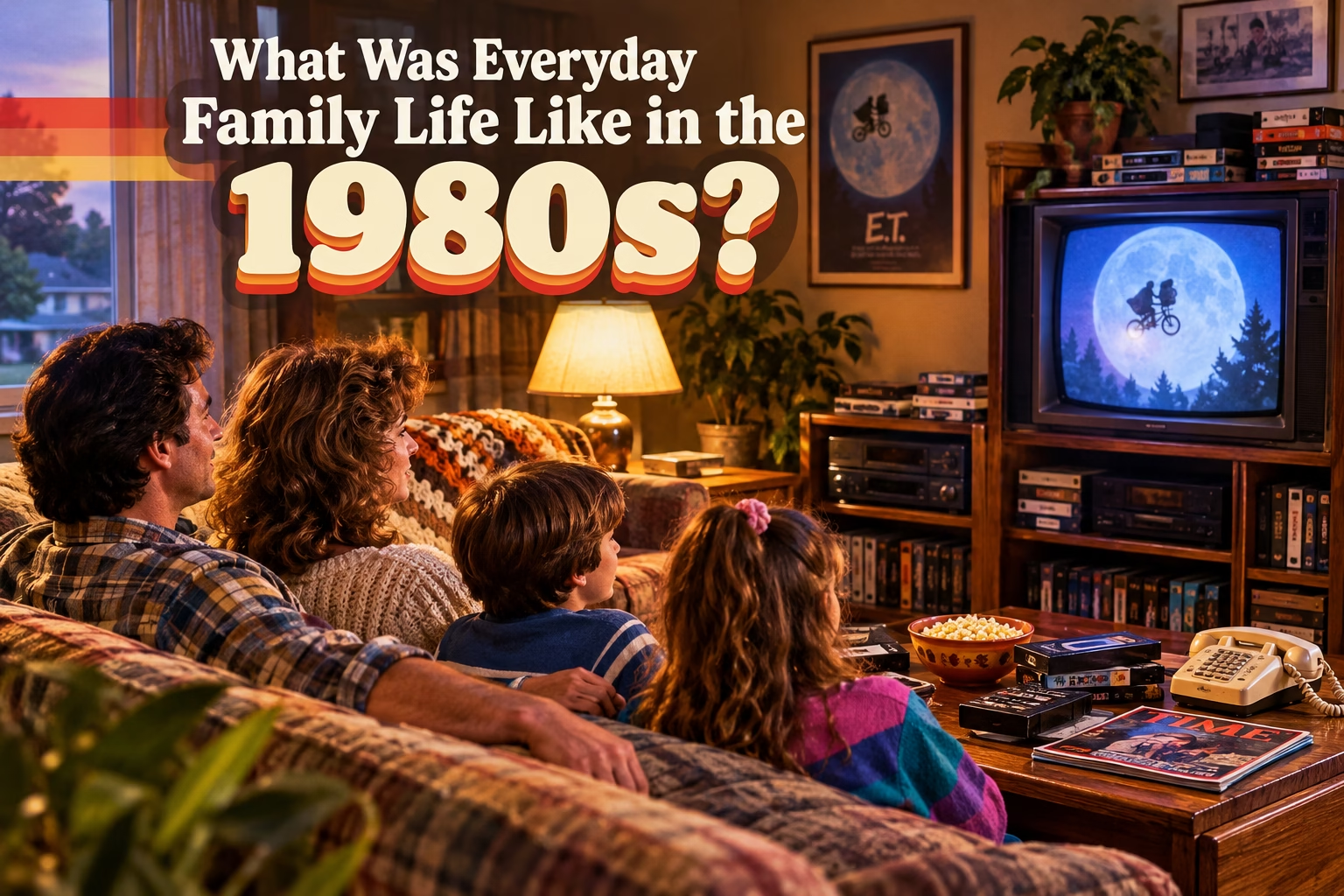
From family dinners and television nights to neighborhood adventures, household chores and the rise of home technology, discover what ordinary family life really felt like during the 1980s.
Everyday family life in the 1980s was shaped by routines that may seem surprisingly simple today. Families certainly had technology, entertainment and busy schedules, but the way people used those things was very different.
For many households, the home remained the central place for eating, relaxing, talking, watching television and spending time together. Children often had more reasons to go outside, while communication usually required a telephone call, a letter or a face-to-face meeting.
Of course, there was no single 1980s family experience. Life differed according to country, culture, income, location and family circumstances. Still, the decade had a recognizable rhythm that separated it from both earlier decades and the highly connected world of today.
📻 Explore the bigger picture: How People Used to Live in the 1980s →🏠 The Home Was the Center of Family Life
For many families, home was where most everyday activities came together. People ate meals, watched television, listened to music, did homework, completed household chores and relaxed in the same physical space.
The typical living room might contain a television, a sofa, chairs, a stereo system, books, magazines and perhaps a collection of records or cassette tapes.
There were no smartphones sitting on the coffee table. There was no family group chat. There was no tablet for every child.
Instead, family members generally shared the entertainment and communication devices available in the household.
📺 Television Was Often a Family Event
Television was one of the most important forms of home entertainment during the 1980s. Families could spend evenings watching sitcoms, dramas, cartoons, news programs, movies and special broadcasts.
But television worked differently from today’s streaming services. Viewers generally watched whatever was scheduled by the broadcaster.
If a favorite program started at 8 p.m., you needed to be near the television at 8 p.m. There was no guarantee that you could simply watch it tomorrow.
This created shared viewing experiences. Family members often watched the same programs at the same time, and popular television shows became common conversation topics at school, work and among neighbors.
What Was on Tonight?
Choosing something to watch could be surprisingly simple. Families could look at a television guide, check a newspaper or simply turn on the television and see what was available.
There was no endless scrolling through hundreds of thumbnails while trying to decide what to watch.
🍽️ Family Meals Had a Different Rhythm
Family meals varied enormously from household to household, but dinner could be an important moment for everyone to sit down together.
Parents came home from work, children returned from school, and the family could talk about what had happened during the day.
Not every family ate together every night, and busy households certainly existed. However, there were fewer digital distractions competing for everyone’s attention.
There was also no smartphone delivery app displaying dozens of restaurants at the touch of a button.
Takeaway Was a Different Experience
Takeaway food existed long before the 1980s, but ordering it required more traditional methods.
A family might telephone a restaurant, visit the restaurant or simply prepare something at home.
There was no live delivery map showing the exact location of the driver. If you wanted to know when the food would arrive, you generally had to wait.
☎️ The Telephone Belonged to the Whole Family
One of the most memorable differences between family life in the 1980s and today was the household telephone.
A family might have one main landline. When it rang, everyone could hear it.
This created some interesting situations, especially for teenagers. Calling a friend meant calling the friend’s home.
There was always a possibility that a parent or sibling would answer first.
There was also no caller texting “Where are you?” if someone did not answer. Communication required patience and planning.
📼 VHS Changed Family Movie Nights
The rise of VHS was one of the biggest changes in home entertainment during the 1980s.
Families could record television programs and rent movies from video stores. This gave households more control over entertainment than traditional broadcast television alone.
Going to a video rental store could become a family activity in itself. People walked along shelves filled with VHS cases and tried to agree on which movie everyone wanted to watch.
There was one major problem: someone else might already have rented the movie you wanted.
There was no “stream something similar” button. The empty shelf meant the movie was unavailable.
🎵 Music Was a Physical Part of the Home
Music played an important role in 1980s family and youth culture. People listened to radio stations, vinyl records and cassette tapes, while compact discs became increasingly popular during the decade.
Music collections were physical. A bedroom might contain records, cassette tapes, posters and a stereo system.
📼 Making a Mixtape Took Time
A mixtape was essentially a homemade playlist, but creating one required considerably more effort than making a playlist today.
You had to select songs, record them onto a blank cassette and organize the order.
People could also write titles on the cassette case or decorate it by hand. A carefully prepared mixtape could feel genuinely personal.
🧹 Household Chores Were Part of Everyday Life
Every family had work to do around the home.
Cleaning, cooking, washing clothes, shopping, organizing bedrooms and taking care of younger children were all part of everyday routines.
Children could also have responsibilities. Depending on the household, they might make their beds, clean their rooms, wash dishes, take out rubbish, feed pets or help younger brothers and sisters.
There were no smart-home notifications reminding everyone about chores. Parents usually had a much simpler technology:
That sentence has apparently survived every technological revolution.
🧒 Children Often Spent More Time Outside
Children in the 1980s certainly watched television and played video games, but entertainment was generally less portable.
A child could not carry hundreds of games, videos and social media apps inside a smartphone because smartphones did not exist.
As a result, meeting friends often meant physically going somewhere. Children might ride bicycles, play football or other sports, visit friends, go to parks, play in the neighborhood or spend time at local arcades.
Of course, this varied greatly by location and family rules. Some children had more freedom than others.
But the simple act of going outside could be a normal part of an afternoon.
🕹️ Video Games Became Part of Family Entertainment
The 1980s were a major period for video games. Arcade culture became popular, while home consoles brought gaming into living rooms.
Gaming was still much more physical and local than it is today.
If you wanted to compete with a friend, that friend was often sitting right beside you.
There were no enormous online communities connecting players across the world through modern gaming networks.
Sometimes the biggest challenge was simply deciding whose turn it was.
🏫 School Life Was Mostly Offline
For families with school-age children, school routines were very different. Students relied heavily on teachers, textbooks, notebooks and libraries.
If a student needed information for a project, searching for it could take considerable time.
There were no search engines capable of returning millions of results within seconds.
📚 Research Meant Finding a Book
Students could visit libraries and search through reference books. They might copy information by hand into notebooks before preparing an assignment.
The process was slower, but it also required students to physically interact with books and information sources.
🛒 Shopping Was a Physical Activity
Shopping usually meant leaving the house.
Families visited supermarkets, local stores, markets, department stores and shopping centers.
Parents could compare products on shelves, read labels and ask shopkeepers questions.
Online shopping was not part of ordinary family life on anything resembling today’s scale.
Today: “I ordered it online.”
Catalog shopping did exist, so physical stores were not the only way to buy certain products. But the instant convenience of modern online shopping was still far in the future.
🏘️ Neighborhoods Were Important Social Spaces
For many families, the neighborhood was an extension of the home.
Children knew other children who lived nearby. Adults could know their neighbors, local shopkeepers and other members of the community.
People visited each other’s homes, arranged meetings and interacted face-to-face.
Digital communities did not replace local communities because they had not yet become a major part of everyday life.
This did not mean every neighborhood was perfectly friendly or safe. Experiences varied greatly. But physical proximity played a much larger role in everyday social life.
📞 Making Plans Required More Organization
Today, changing plans can take seconds. You can send a message saying, “Running late,” and everyone immediately knows.
In the 1980s, making plans often required more preparation.
Friends could arrange to meet at a particular time and place. If plans changed, someone might need to make a telephone call.
If you could not reach the person, you might simply have to wait and see what happened.
That could be the entire plan.
📸 Family Photos Were Different
Photography was another part of family life that technology transformed.
Most families used film cameras rather than smartphones.
A roll of film contained a limited number of photographs. Taking a picture therefore required at least a little thought.
Afterwards, the film had to be developed before the family could see the results.
There was no instant preview and no deleting dozens of unwanted photographs.
A blurry family picture could become part of the family photo album forever.
🎂 Birthdays Were Full of Physical Memories
Birthdays and family celebrations were important occasions, just as they are today.
People exchanged wrapped presents, physical greeting cards and printed photographs.
Invitations might be handwritten or printed rather than sent through a social media platform.
Family celebrations could therefore leave behind physical memories: photograph albums, cards, decorations and keepsakes.
📰 News Came Through Television, Radio and Newspapers
Families could follow current events through newspapers, radio broadcasts and television news.
There was no social media feed refreshing every few seconds.
There were no constant push notifications announcing every new development.
For some people, this meant that information entered the home in a more predictable rhythm.
A newspaper at breakfast, a radio broadcast or an evening news program could become part of the daily routine.
🚗 Family Travel Needed More Preparation
Traveling by car in the 1980s could be an adventure.
Modern cars can contain navigation systems, entertainment screens, smartphone connectivity and other digital conveniences.
Families in the 1980s relied much more heavily on printed maps and road signs.
Getting lost was a genuine possibility.
If someone did not know where they were going, they might stop and ask someone for directions.
💻 Technology Was Already Beginning to Change Everything
It is important not to imagine the 1980s as a completely technology-free decade.
The opposite was true. The decade saw rapid technological development. Personal computers became increasingly visible, video games became popular, home video expanded and new electronic devices entered homes.
The difference was that these technologies were still relatively new and limited compared with today’s connected devices.
A family computer did not automatically mean that every family member was connected to the internet.
A video game console did not automatically connect players to millions of people around the world.
Technology was beginning to transform daily life, but the digital revolution was still in its early stages.
👨👩👧👦 Family Conversations Happened Face-to-Face
One of the biggest differences between family life in the 1980s and today was simply how often people were physically together.
Family members could talk around the dinner table, in the living room, in the car or while doing household chores.
Of course, families had arguments, disagreements and busy schedules just like families today.
The difference was that digital communication did not provide another constant layer of interaction.
There were fewer notifications interrupting conversations.
⏰ Daily Routines Felt More Predictable
For many people, the rhythm of everyday life followed a relatively predictable pattern.
- Wake up and get ready for school or work.
- Eat breakfast.
- Travel to school or work.
- Return home later in the day.
- Complete homework or household responsibilities.
- Eat dinner.
- Watch television, listen to music or talk with family.
- Prepare for bed.
Of course, this is a simplified picture. Real families were much more complicated, and many households had completely different routines.
But compared with modern life, there were fewer digital interruptions capable of filling every quiet moment.
📊 1980s Family Life vs. Family Life Today
| Everyday Activity | 1980s | Today |
|---|---|---|
| Communication | Landline telephone, letters, face-to-face conversations | Smartphones, messaging apps, video calls |
| Entertainment | Broadcast TV, VHS, radio, records, cassettes | Streaming, social media, gaming platforms |
| Music | Records, cassettes, radio, CDs | Streaming and digital libraries |
| Photography | Film cameras | Smartphones and digital cameras |
| Shopping | Stores, malls, markets, catalogs | Physical stores plus online shopping |
| Research | Books, libraries, teachers | Search engines, websites and digital databases |
| Navigation | Maps and road signs | GPS and navigation apps |
| Socializing | Neighborhoods, schools and physical visits | Physical and online communities |
🤔 Was Family Life Actually Better in the 1980s?
This is where nostalgia can become misleading.
Some people remember the 1980s fondly because they associate the decade with childhood, family gatherings, music, television shows and simpler technology.
But the decade also had its challenges.
Access to information was more limited. Communication could be inconvenient. Some household tasks were more time-consuming. Entertainment options were smaller. Certain technologies that are now extremely useful simply did not exist.
So it would be inaccurate to say that life was universally better or worse. It was simply different.
❤️ Why Do People Feel Nostalgic About 1980s Family Life?
Nostalgia is powerful because people often remember periods of their lives through emotions rather than technology.
Someone may remember a Saturday morning cartoon, a family road trip, a favorite cassette, a birthday party or a particular television show.
The memory is not necessarily about the technology itself.
It is about the people who were there.
That is why 1980s nostalgia remains so popular. The decade has become a symbol of a period when entertainment was more physical, communication was slower and family routines could feel more predictable.
🌟 The Biggest Difference Was Not Technology
It might be tempting to say that the biggest difference between family life in the 1980s and today was the absence of smartphones.
But the deeper difference was the way technology affected attention.
A television had a particular location. A telephone had a particular location. A computer had a particular location.
Today, many people carry several communication and entertainment tools everywhere they go.
The 1980s therefore created more physical boundaries between activities.
When you left the house, you could genuinely leave some forms of communication behind.
🔗 Want to Explore More About Life in the 1980s?
Everyday family life was only one part of the story. The decade also transformed fashion, music, television, shopping, technology, school, travel, food, photography and entertainment.
If you want a broader look at the way ordinary people lived during the decade, continue with our complete guide:
📺 How People Used to Live in the 1980s — The Complete Guide →That article brings together the larger picture of everyday life and explores the many details that made the 1980s such a distinctive decade.
❓ Frequently Asked Questions
What was family life like in the 1980s?
Family life in the 1980s often revolved around the home, school, work, television, meals, household chores and neighborhood activities. Technology was present but much less connected than it is today.
Did families watch television together in the 1980s?
Many families did watch television together because households generally had fewer televisions and fewer entertainment options than they have today. However, viewing habits varied from family to family.
How did people communicate with family and friends in the 1980s?
People commonly used landline telephones, letters and face-to-face conversations. Personal mobile messaging and social media did not exist as everyday communication tools.
What did children do for fun in the 1980s?
Children watched television, played video games, rode bicycles, played sports, visited friends, went to parks, played outdoors and spent time at arcades. Activities varied considerably depending on location and family circumstances.
Did people have computers in the 1980s?
Yes. Personal computers became increasingly common during the decade, although access varied considerably. Computers were far less powerful, connected and portable than modern devices.
How did families watch movies in the 1980s?
Families could watch movies broadcast on television, record programs or rent VHS tapes from video rental stores. Home video made movie nights more flexible than traditional television schedules alone.
Why do people remember the 1980s so fondly?
Nostalgia often connects the decade with childhood memories, music, television, family gatherings, friendships and cultural experiences. People may miss the feelings associated with those memories rather than the technology itself.
Final Thoughts: A Slower but Very Different Family Rhythm
Everyday family life in the 1980s was not perfect, and it was certainly not identical for everyone. Families faced their own financial, social and personal challenges.
What makes the decade interesting today is the dramatic contrast with modern life.
Families communicated through shared telephones. Children played outside. Television schedules determined when programs were watched. Music existed on physical tapes and records. Photographs had to be developed. Shopping required a trip to a store. Maps were made of paper.
At the same time, the 1980s were already introducing technologies that would eventually transform the modern world.
That combination makes the decade fascinating: it was both familiar and completely different.
And perhaps the most important lesson is that technology changes incredibly quickly, while the basic things families value—time together, friendship, entertainment, celebrations and shared memories—remain surprisingly constant.
For the complete story of everyday life during this fascinating decade, explore: How People Used to Live in the 1980s .
