
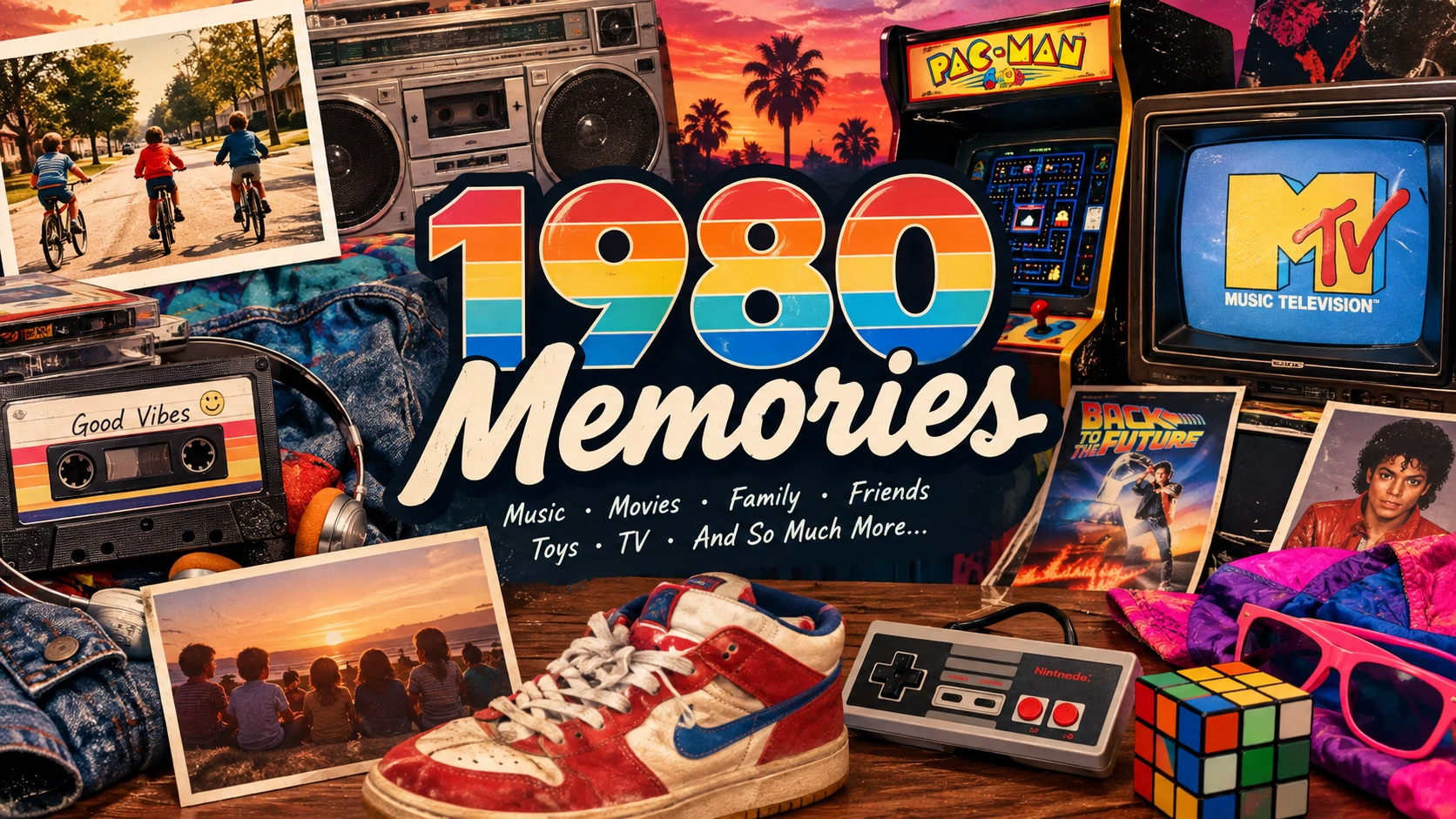
How People Used to Live in the 1980s
Before smartphones, streaming, social media and Wi-Fi followed us everywhere, everyday life had a completely different rhythm. Welcome to the wonderfully strange, colorful and sometimes hilarious world of the 1980s.
Imagine waking up in the 1980s. There is no smartphone waiting beside your bed. There are no notifications, no group chats, no online shopping and definitely no mysterious little device tracking how many steps you took yesterday.
You get out of bed, turn on the radio or television, eat breakfast and start your day. If you want to talk to a friend, you might call their home phone. If they are not there, well… you simply try again later. There is no “seen” message, no blue tick and no dramatic question: “Why did you leave me on read?”
The 1980s were a fascinating decade of rapid change. Technology was becoming more visible, music and television were becoming increasingly influential, colorful fashion was everywhere, and families were beginning to experience the early stages of the digital revolution. Yet most ordinary routines remained wonderfully simple.
🏠 Life at Home Was Much Less Digital
The average home of the 1980s looked very different from a modern home. There were televisions, radios, telephones, cassette players and increasingly sophisticated electronic appliances, but the digital world had not yet taken over every corner of domestic life.
A television was often one of the most important pieces of technology in the house. Families gathered around it in the evening, especially when a favorite program, movie or major sporting event was on. There was no endless library of entertainment waiting for someone who couldn’t decide what to watch.
You watched what was being broadcast. If the program was boring, you had several options: watch it anyway, talk to someone, read a book, listen to music or simply leave the room. The phrase “I’m going to watch something else” did not necessarily mean changing between 500 channels.
📺 The Television
Television was a central source of entertainment. Families often watched programs together, and television schedules could actually influence people’s routines.
☎️ The Telephone
Home telephones were essential. Calling someone meant dialing their number, waiting for them to answer and possibly speaking to their parent or sibling first.
📻 The Radio
Radio remained an important source of music, news and entertainment. People could discover songs without an algorithm deciding what they should hear next.
📼 VHS Players
Video cassette recorders brought a new kind of flexibility. People could record programs, rent movies and build collections of favorite films.
☎️ Calling Someone Was an Actual Event
Today, sending a message can take two seconds. In the 1980s, contacting someone required a little more planning.
Most families had a telephone at home, usually in a fixed location. You could not casually walk around the supermarket while talking to someone on a mobile phone. You stayed near the phone because the phone stayed near the wall.
And then came the greatest challenge: calling a friend whose family answered first.
“Who is this?”
Welcome to the original parental firewall.
Teenagers especially had to navigate the social complications of a shared family telephone. A conversation that would now happen privately through a messaging app might have been overheard by siblings, parents or anyone else standing nearby.
There was also no caller ID in many homes, meaning you often had no idea who was calling until someone answered.
🎵 Music Meant Cassettes, Records and Patience
Music was one of the defining elements of 1980s culture. Pop, rock, new wave, electronic music, hip-hop and many other genres developed or reached enormous audiences during the decade.
But listening to music required physical media. People bought vinyl records, cassette tapes and, later in the decade, compact discs. Music collections were physical collections.
📼 The Mixtape Was a Love Language
One of the most memorable 1980s habits was creating mixtapes. People carefully selected songs, recorded them onto blank cassette tapes and sometimes decorated the covers with handwritten titles.
Creating a good mixtape required effort. You couldn’t simply create a playlist, press save and instantly send it to someone. You had to choose the songs, record them, check the order and hope the tape didn’t suddenly decide to become a tangled plastic snake.
Cassette tapes also had their own tiny piece of technology that became legendary: the pencil.
When a cassette became tangled, a pencil could sometimes help wind the tape back into place. Today, a pencil is mostly something you use to write. In the cassette era, it could briefly become an emergency repair tool.
📺 Watching Television Was a Shared Experience
Streaming services have changed entertainment completely. In the 1980s, television programming was much more scheduled.
If a favorite show started at 8:00 p.m., you tried to be in front of the television at 8:00 p.m. Missing an episode could mean waiting for a rerun or simply accepting that you would never know what happened.
This created something that is less common today: shared cultural moments. Large numbers of people could watch the same program at roughly the same time and discuss it the next day.
The funny part? Nobody could say, “I’ll just watch it later.” Later was not always an option. The television schedule was the schedule.
🎬 VHS Changed Movie Nights
The arrival and growing popularity of home video transformed entertainment. Instead of relying entirely on television schedules or going to the cinema, families could rent or buy movies on VHS.
Video rental stores became destinations in their own right. People walked between shelves of colorful cassette boxes, read descriptions and argued over which movie to choose.
The great tragedy was arriving at the store and discovering that the movie you wanted was already rented.
There was no digital library politely suggesting another film. You simply stared at the empty space on the shelf and experienced a tiny personal crisis.
🕹️ Video Games Were Becoming a Big Deal
The 1980s were an important period for video games. Arcades were popular in many places, while home consoles increasingly became part of family entertainment.
Children and teenagers could spend time playing games in arcades or at home. However, gaming was usually much less portable than it is today.
There were no smartphones packed with games. There was no cloud gaming. There was no enormous online community available instantly from the bedroom.
If you wanted to play with friends, you often had to physically meet them. Revolutionary concept, isn’t it?
🕹️ The Arcade Social Life
Arcades were not only places to play games. They could also be social spaces where young people met friends, watched other players and competed for high scores.
👕 Fashion Was Bold, Colorful and Impossible to Ignore
The 1980s were famous for fashion that was not particularly interested in being subtle.
Bright colors, denim, tracksuits, oversized clothing, leather jackets, colorful accessories and distinctive hairstyles were all part of the decade’s visual identity.
Fashion trends varied greatly depending on country, age, social group and economic circumstances. There was no single “1980s outfit.” Instead, the decade contained many different styles.
👟 Sneakers
Sports shoes increasingly became everyday fashion items rather than clothing reserved only for exercise.
👖 Denim
Jeans and denim jackets were popular across many youth cultures and fashion scenes.
💇 Big Hairstyles
Hair could be dramatic, voluminous and carefully styled. The decade did not exactly believe in whispering.
🕶️ Accessories
Sunglasses, watches, colorful jewelry, belts and other accessories helped complete many popular looks.
🏫 School Life Was Very Different
Students in the 1980s did not have instant access to search engines, online encyclopedias or educational videos. Research usually involved books, teachers, libraries and handwritten notes.
If a teacher asked students to find information about a historical person, a country or a scientific topic, the process could involve visiting a library and searching through physical reference books.
There was also no classroom group chat where students could ask, “What was the homework?” at 11:47 p.m.
Notes were written by hand.
And if you forgot the assignment… you couldn’t blame a dead phone battery.
Computers were beginning to enter educational environments, but they were nowhere near as common or powerful as modern devices. Typing an essay was not necessarily something every student could do on a personal laptop.
💼 Work Was Mostly Offline
The workplace was also undergoing technological change. Computers were becoming increasingly important in offices, but many everyday tasks were still performed with paper documents, filing cabinets, typewriters, calculators and physical mail.
Communication between businesses could involve letters, telephone calls and increasingly fax machines.
Imagine needing to send a document and thinking, “I’ll fax it.” No email attachment. No instant PDF. No “I accidentally sent the wrong version to everyone.”
Of course, mistakes still happened. They just required different technologies.
🛍️ Shopping Was a Physical Experience
Shopping meant physically going somewhere. There was no ordering something at midnight while lying in bed and expecting a delivery notification the next morning.
People visited supermarkets, department stores, local shops and markets. They looked at products, compared prices and spoke directly with shopkeepers.
Catalog shopping also existed, allowing people to order certain products without visiting a store, but online shopping was still decades away from becoming part of ordinary everyday life.
🍳 Food and Family Meals
Food habits varied enormously around the world, but family meals were often an important part of everyday life. Home cooking was common, and many families had established routines around breakfast, lunch and dinner.
Refrigerators, microwaves and other household appliances were increasingly common, but convenience foods and eating habits differed considerably depending on country, income and family traditions.
The idea of ordering almost any meal from an app did not exist. If you wanted takeaway food, you generally had to phone the restaurant, visit it or simply go without.
🚗 Cars Were More Than Transportation
Cars in the 1980s were beginning to look increasingly modern, but compared with today’s vehicles they were technologically simple.
There were no smartphone dashboards, navigation apps, streaming services built into the car or digital assistants answering questions from the passenger seat.
Getting lost was entirely possible.
And when people got lost, they did not necessarily become angry at Google Maps. They stopped and asked someone for directions.
🗺️ The Original Navigation System
“Excuse me, can you tell me how to get there?”
It had no battery, no signal problems and no software updates. It did, however, occasionally provide completely incorrect directions.
✈️ Travel Required More Preparation
Travel was possible and increasingly accessible to many people, but planning a trip usually involved more physical preparation.
Travelers might use maps, printed travel guides, brochures, travel agents and paper tickets. There was no instant online search for hundreds of hotels and flights from the comfort of a sofa.
Travel agents played an important role in helping customers organize holidays, flights and accommodation.
Once again, the absence of smartphones meant that people had to remember more information themselves. Hotel addresses, telephone numbers, directions and travel details might all be written down somewhere.
👨👩👧👦 Family and Neighborhood Life
Family and neighborhood routines differed greatly across cultures, but many people experienced a more physically connected local environment.
Children often spent time outdoors, visiting friends’ homes, playing in streets or parks, riding bicycles and participating in organized sports.
That does not mean every child in the 1980s lived outside from sunrise to sunset. Television, video games, books and other indoor activities were also important. But there was no smartphone competing for attention every few minutes.
Social interaction generally required people to be physically present or to use the telephone.
One major difference: boredom was often something people had to solve themselves. There wasn’t an infinite digital entertainment machine sitting in their pocket.
📸 Taking Photos Took More Planning
Photography was another area where technology has transformed everyday life. People generally used film cameras rather than smartphones.
A roll of film had a limited number of exposures. That meant people had to think before taking a picture.
You couldn’t take 47 photographs of your sandwich and delete 46 later.
After the film was finished, it had to be developed. Only then could you discover whether the picture was good, blurry, badly framed or accidentally taken while someone was still putting the camera away.
💌 Letters and Physical Mail Were Still Important
Written letters were a genuine form of communication. People sent postcards, birthday cards, invitations, thank-you notes and personal letters.
Receiving a letter could feel special because it required someone to physically write something, put it into an envelope, address it, add a stamp and send it.
There was no instant reply. Waiting was simply part of communication.
📰 News Came Through Newspapers, Radio and Television
People received news through newspapers, radio broadcasts and television news. There was no social media feed updating every few seconds.
This meant that information traveled at a different pace. Major events were still reported quickly through broadcast media, but people generally had fewer sources competing for their attention.
Today, a person can encounter thousands of headlines in a week without actively searching for them. In the 1980s, getting news usually involved intentionally turning on the television, listening to the radio or reading a newspaper.
🏋️ Health, Exercise and Daily Routines
Fitness culture existed in the 1980s and became especially visible through aerobics, jogging, sports clubs and home exercise programs.
However, there were no smartwatches constantly counting steps, monitoring heart rate or congratulating you for standing up.
People exercised because they wanted to be active, improve fitness, participate in sports or simply enjoyed it.
The modern quantified-self movement had not yet arrived with its collection of graphs, rings and notifications.
💻 The Beginning of the Computer Age
Perhaps the most fascinating part of the 1980s was that the future was already arriving.
Personal computers were becoming more visible in homes, schools and workplaces. People were learning about word processing, programming, computer games and digital storage.
Yet these machines were primitive compared with today’s computers. Storage was limited, screens were basic and graphical interfaces were still developing.
Connecting to the internet as we know it today was not a normal household experience for most people.
The idea that almost every person would one day carry a powerful computer in their pocket would have sounded like science fiction.
🔮 What Did People Think the Future Would Look Like?
This is one of the funniest parts of looking back at the 1980s.
People were fascinated by the future. Films, television programs and advertisements imagined advanced robots, flying cars, futuristic cities and incredible computers.
Some predictions were surprisingly accurate. Others were spectacularly wrong.
We eventually got smartphones, video calls, voice assistants and cars with increasingly sophisticated technology.
But flying cars are still waiting for their big entrance.
| 1980s Expectation | What Actually Happened |
|---|---|
| Super-powerful personal computers | Yes — and now they fit in our pockets. |
| Video calls | Absolutely normal today. |
| Information available instantly | The internet went far beyond expectations. |
| Flying cars everywhere | Still waiting. |
| Robots doing everything | Robots exist, but humans still have plenty of work. |
😂 The Things People Didn’t Have to Worry About
Looking at the 1980s from a modern perspective reveals some amusing differences.
- No smartphone battery anxiety.
- No Wi-Fi password arguments.
- No social media notifications.
- No accidental screenshots.
- No accidentally sending a message to the wrong group chat.
- No endless streaming-service decisions.
- No smartphone falling into the toilet.
- No phone camera storage problems.
- No video meeting where someone says, “You’re on mute.”
Of course, the 1980s had plenty of its own problems. Life was not magically easier simply because technology was less advanced. Medical care, transportation, communication, employment and many other aspects of society have changed dramatically since then.
The point is not that one decade was universally better. It is that the rhythm of ordinary life was different.
❤️ Why Do People Feel Nostalgic About the 1980s?
Nostalgia is powerful because people often remember more than objects. They remember experiences.
A cassette tape can remind someone of a childhood bedroom. A particular television show can bring back memories of family evenings. A smell, a song, an old advertisement or a photograph can suddenly transport someone back decades.
For many people, the 1980s represent a period when technology was becoming exciting without yet becoming completely unavoidable.
Computers were fascinating. Video games were exciting. Music technology was changing. Television was expanding. But people still had large parts of everyday life that were completely offline.
🌟 A Typical 1980s Day
So what might an ordinary day have looked like?
You wake up and get ready without checking your phone because your phone doesn’t live beside your pillow. You eat breakfast. You go to school or work.
During the day, you communicate with people face-to-face or by telephone. If you need information, you ask someone, look it up in a book or search through another physical source.
After school or work, you might meet friends, play sports, visit relatives, listen to music, watch television, read or play video games.
In the evening, the family may gather around the television. Someone might record a program on VHS. Someone else might listen to a cassette. A parent might read a newspaper.
Eventually, you go to bed.
And nobody spends another 45 minutes scrolling through videos because the internet doesn’t exist in your bedroom.
“Good night.”
Modern bedtime:
“Good night. Let me just check one thing…”
Two hours later…
📊 The 1980s vs. Today
| Everyday Activity | 1980s | Today |
|---|---|---|
| Communication | Telephone, letters, face-to-face | Messaging, video calls, social media |
| Music | Vinyl, cassette, radio, CD | Streaming and digital files |
| Movies | Cinema, television, VHS | Streaming, cinema, downloads |
| Photography | Film cameras | Smartphones and digital cameras |
| Shopping | Physical stores and catalogs | Physical and online shopping |
| Navigation | Maps and asking people | GPS and navigation apps |
| News | Newspapers, radio and TV | Websites, apps, social media and TV |
| Research | Books, libraries and experts | Search engines and digital databases |
🎉 The 1980s Were a Decade of Transition
The most interesting way to understand the 1980s is not simply to describe them as an old-fashioned decade. They were a bridge between two worlds.
Traditional forms of communication, entertainment and family life were still dominant, while computers, video games, cable television, home video and new consumer technologies were rapidly changing people’s expectations.
It was a decade when the future started becoming visible.
People could see that technology was going to transform their lives, but they could not yet imagine just how completely it would happen.
🌈 What We Can Learn From 1980s Life
Looking back at the decade can teach us something beyond nostalgia.
Technology is incredibly useful, but it also changes how we spend our attention. The 1980s remind us that entertainment does not have to be endless to be enjoyable, communication does not always need to be instant, and boredom can sometimes encourage creativity.
People had fewer digital conveniences, but they still found ways to entertain themselves, stay connected, discover music, enjoy movies, make friends and build communities.
They also had something that is increasingly valuable today: moments when nothing was demanding their attention.
The biggest difference wasn’t technology.
It was the pace of life. The 1980s were not perfect, but many everyday activities required people to slow down, wait, meet in person and be present.
❓ Frequently Asked Questions About Life in the 1980s
What was everyday life like in the 1980s?
Everyday life depended heavily on country, family, income and location, but compared with today it generally involved much less digital technology. People relied on television, radio, telephones, newspapers, physical stores, books, cassette tapes, records and face-to-face communication.
Did people have computers in the 1980s?
Yes. Personal computers became increasingly common during the decade, although they were much less powerful and widespread than today’s computers and smartphones.
How did people listen to music in the 1980s?
People listened to music through radio, vinyl records, cassette tapes and, increasingly during the decade, compact discs. Making mixtapes on cassette was also a popular activity.
How did people communicate without smartphones?
They used landline telephones, letters, postcards and face-to-face conversations. In workplaces and businesses, communication could also involve fax machines and other forms of written correspondence.
Did people have video games in the 1980s?
Yes. Arcades were popular, and home video-game consoles became increasingly important forms of entertainment during the decade.
How did people watch movies at home?
Television was important, while VHS players and video rental stores gave people another way to watch movies at home.
Was life in the 1980s better than life today?
There is no universal answer. Modern technology provides enormous advantages in communication, information, medicine, transportation and entertainment. At the same time, some people feel nostalgic for the slower pace and more offline social life of earlier decades.
Why are people nostalgic about the 1980s?
Nostalgia is often connected to personal memories. Music, television, fashion, family routines, childhood experiences and physical objects can all trigger strong emotional memories of a particular period.
🎬 Final Thoughts: Welcome Back to the 1980s
Life in the 1980s was neither a perfect golden age nor a technological disaster. It was simply different.
People lived without many of the conveniences that we now consider essential. They waited for photographs to be developed, waited for letters to arrive, waited for television programs to start and waited for friends to call back.
Yet they also experienced a world that was beginning to change dramatically. Computers entered homes. Video games became mainstream. VHS transformed home entertainment. Music became increasingly portable. Television became more influential. Fashion became louder. Technology became more personal.
The decade was colorful, experimental and sometimes wonderfully ridiculous.
Perhaps that is why the 1980s continue to fascinate people decades later. They remind us of a time when the future was arriving, but it hadn’t yet taken over every spare minute of the day.
📼 One Last Trip Back in Time
Imagine sitting in a bedroom with a cassette player nearby, a stack of magazines on the desk, a television glowing in the corner and a handwritten list of songs waiting to become your next mixtape.
No notifications. No endless scrolling. No Wi-Fi password.
Just music, friends, television, imagination and time.
And somehow, the VCR is still flashing 12:00. 😄
