
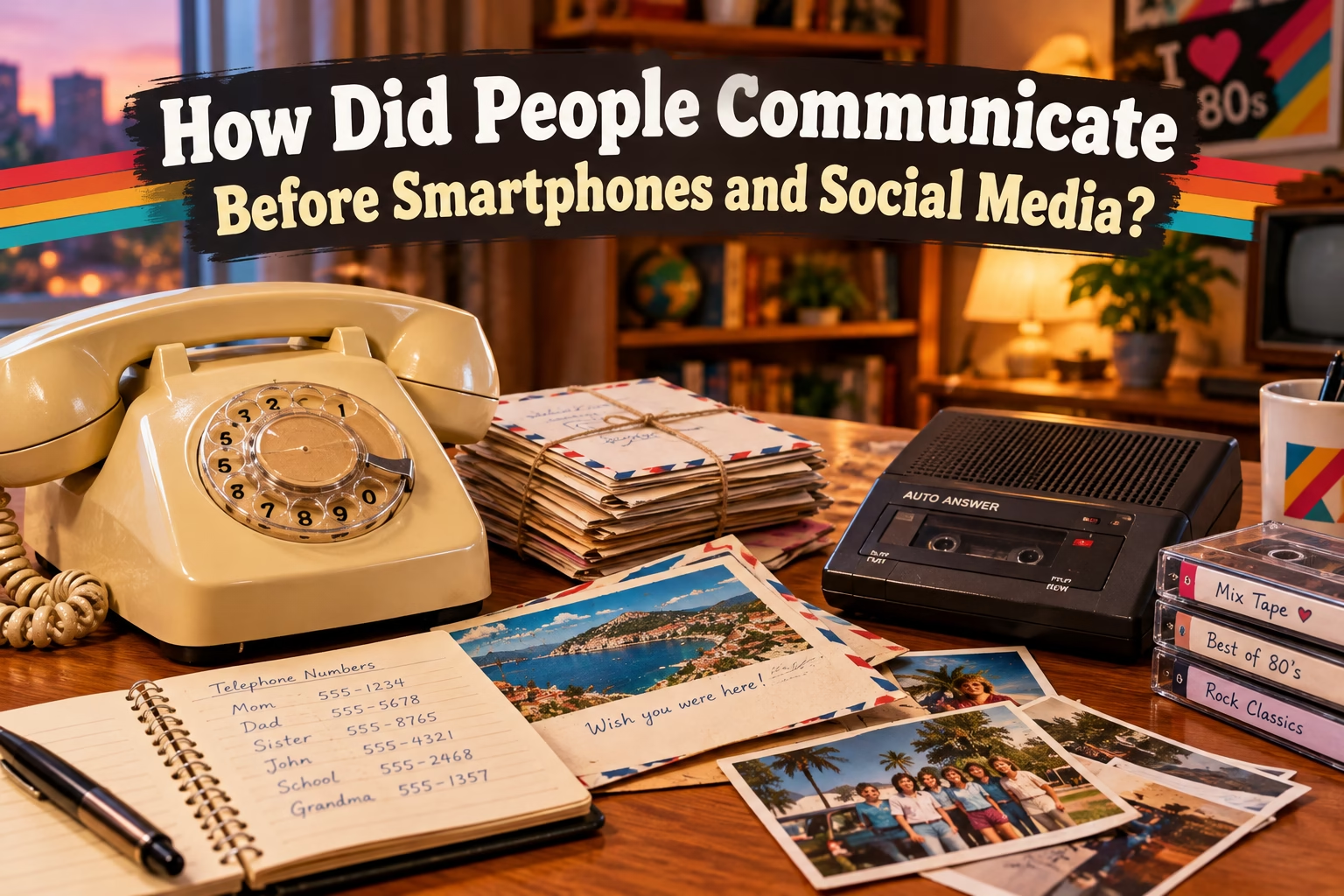
Before smartphones, instant messaging, social media and video calls, staying in touch required something many people today rarely need: patience. In the 1980s, communication was slower, more physical and often more personal. People called from landlines, wrote letters, left messages, made plans in advance and simply showed up at someone’s house.
Imagine wanting to talk to your best friend in the 1980s. You could not simply unlock your phone, open a messaging app and type, “Are you free?” There were no smartphones sitting in everyone’s pockets, no group chats buzzing throughout the day and no social media notifications appearing every few minutes.
Instead, you might pick up the telephone at home, dial your friend’s number and hope they were there to answer. If nobody picked up, you had a few choices: call later, leave a message if an answering machine was available, or simply wait.
That slower rhythm was one of the defining characteristics of everyday life in the 1980s. Communication still happened constantly, but the tools were different. Telephones, handwritten letters, postcards, newspapers, magazines, answering machines, fax machines and face-to-face conversations all played important roles.
If you want to understand the bigger picture, take a look at our complete guide to how people used to live in the 1980s. Communication was just one part of a much larger lifestyle that feels surprisingly different from today’s always-connected world.
📻 Explore the Complete Guide: How People Used to Live in the 1980s →Communication in the 1980s Was Slower — But Not Necessarily Worse
Modern communication is incredibly fast. A person can send a message across the world in seconds. Photos can be shared instantly, video calls can connect families thousands of miles apart, and social media allows people to follow the lives of friends and strangers.
In the 1980s, communication worked differently. The technology available to ordinary families placed natural limits on how quickly people could reach one another.
Those limitations influenced everyday behavior. People often arranged meetings ahead of time. They remembered telephone numbers. They knew where their friends lived. They made backup plans when something went wrong.
This meant that communication was not just about sending information. It was closely connected to planning, memory, routines and physical places.
The Landline Telephone Was the Center of Communication
For many families, the landline telephone was the most important communication device in the house. It was usually connected to the wall and stayed in one particular location.
Unlike a smartphone, you could not take it with you around town. If you wanted to make a call, you generally had to be at home or find another telephone.
Everyone in the Family Could Answer
One funny difference was privacy. A telephone call was often a family event because everyone could hear the phone ringing.
A parent might answer and say, “It’s for you!” before handing the receiver to a son or daughter. Sometimes a sibling would answer first. Sometimes a friend would call and have to ask for the person they wanted.
There was no caller ID on many household phones, so you often had no idea who was calling until you answered.
This made receiving a phone call feel different from receiving a modern notification. A ringing telephone demanded immediate attention.
Teenagers Could Spend Hours on the Phone
It is easy to assume that people in the 1980s did not communicate much because they lacked modern technology. That is not true.
Teenagers could spend a surprising amount of time talking on the telephone. Long conversations with friends were common, especially when the telephone was located in a bedroom or another relatively private part of the house.
Parents, however, sometimes had a very practical concern: the telephone bill.
A long-distance call could be expensive, so families were often more careful about how long they stayed on the phone and whom they called.
Phone Numbers Had to Be Remembered
One of the strangest things about communication before smartphones was the importance of remembering telephone numbers.
Today, a contact list stores hundreds of numbers. You might not even know the phone number of your closest friend because your phone remembers it for you.
In the 1980s, people often memorized the numbers of family members, friends, neighbors, schools and workplaces.
Many homes also had a small notebook or address book containing important contact information.
Telephone Directories Were Huge
Before online search engines and digital contact databases, telephone directories were an important source of information.
A telephone directory could contain hundreds or thousands of names and numbers. It was usually a large printed book that took up considerable space.
Businesses could be found through specialized business directories, while households were listed alphabetically in residential directories depending on local telephone services and privacy choices.
Looking up a number was a physical process: find the directory, open it, search alphabetically and locate the information.
There was no search box, no autocomplete and no “Did you mean?” suggestion.
What Happened When Nobody Answered?
One of the biggest differences between 1980s communication and modern communication was what happened when someone was unavailable.
Today, you can send a text message, leave a voice message, send an email or contact someone through several social networks.
In the 1980s, there were fewer alternatives.
If someone did not answer the phone, you might simply try again later. You could also leave a message with another family member.
This created a very different sense of time. Not receiving an immediate response was normal.
Answering Machines Changed Everything
Answering machines became an increasingly useful household technology during the 1980s. They allowed callers to leave recorded messages when nobody was available.
This was a major improvement. Instead of calling repeatedly and hoping someone answered, you could leave information and wait for the person to return your call.
The answering machine also introduced a new little ritual: checking messages.
A person might come home, press a button and listen to the recorded messages that had arrived during the day.
There was something surprisingly exciting about hearing the machine announce that you had a message waiting.
Recorded Greetings Became Personal
Families sometimes recorded humorous or creative greetings. The message might simply ask callers to leave their name and number, or it could include a joke.
For teenagers, having a memorable answering-machine message could become part of their personality.
Letters Were Still Important
Long before emails and instant messaging, letters were one of the main ways people communicated over distance.
Writing a letter required more effort than sending a message today. You needed paper, a pen, an envelope and a stamp. You then had to put the letter into a mailbox or take it to a post office.
The recipient had to wait for the postal service to deliver it.
That delay made letters feel special.
People wrote letters to relatives living far away, friends who had moved, pen pals, romantic partners and people they wanted to stay connected with.
A handwritten letter also contained something that digital communication often lacks: the physical personality of the writer. Handwriting, paper, ink and even small imperfections made each letter unique.
Postcards Were Popular for Travel
Going on holiday in the 1980s did not mean uploading dozens of photos to social media while you were still at the beach.
Travelers often bought postcards and sent them to relatives and friends.
A postcard could show a famous monument, a beautiful beach, a city skyline or a hotel. The back usually contained a short handwritten message.
The message might be simple:
- Greetings from our holiday!
- The weather is wonderful.
- Wish you were here.
- We are having a great time.
The recipient then had a physical souvenir that could be kept for years.
Friends Often Made Plans in Advance
Without smartphones, spontaneous communication was more difficult.
Friends often arranged where and when they would meet before leaving home.
Someone might say, “Let’s meet outside the cinema at seven,” and that was the plan. There was no group chat available to change the location five times during the afternoon.
If plans changed, people had to find another way to communicate. They might call the person’s home, ask a mutual friend to pass on the message, or simply accept that the original plan would remain in place.
Meeting Someone Usually Meant Actually Meeting Them
In today’s world, a friendship can involve constant digital interaction without people physically seeing one another.
In the 1980s, communication was often connected to physical spaces.
Friends met at school, at someone’s house, in the neighborhood, at a café, at a sports club, at the cinema or at a shopping center.
A teenager might simply walk or cycle to a friend’s house and knock on the door.
There was no need to send a message first asking whether the person was home.
Knocking on the Door Was Normal
The front door could function almost like a social notification.
A friend might arrive unexpectedly and knock.
Parents would answer the door and call their child. The friend might then wait outside, come in, or suggest going somewhere together.
Neighborhoods were therefore important communication networks. Children and teenagers often knew which houses belonged to their friends and where people usually spent their afternoons.
School Communication Was Mostly on Paper
Schools also depended heavily on physical communication.
Teachers wrote notes, announcements were placed on noticeboards, students copied homework into notebooks and parents received printed messages.
There were no classroom messaging apps, digital learning platforms or instant notifications from teachers.
If a student forgot an assignment, there was no online classroom where they could quickly check the instructions.
Their notebook was often the most important record of what they needed to do.
Businesses Used Fax Machines
While fax machines were not necessarily part of every household’s daily life, they were important in offices during the 1980s.
A fax machine allowed documents to be transmitted through telephone lines. Instead of physically mailing a document, an office could send a copy electronically.
Compared with modern email attachments, faxing was slower and more cumbersome, but at the time it represented impressive communication technology.
Offices could exchange contracts, letters, forms and other documents without waiting for traditional postal delivery.
Newspapers Were a Major Source of Information
Communication was not only about talking to friends and family. People also needed to find out what was happening in the world.
Newspapers were an important source of daily information.
People bought newspapers, read them at breakfast, looked through them at work or shared them with family members.
News was therefore consumed at a different pace.
Instead of refreshing a news website repeatedly, people often waited for the next newspaper edition, television news broadcast or radio bulletin.
Radio Was Still Extremely Important
Radio remained a powerful communication and entertainment medium during the 1980s.
People listened to radio programs in the kitchen, bedroom, car or workplace. Radio stations provided music, news, weather information, interviews and other programs.
A radio could also create a shared cultural experience. Families and friends could listen to the same popular songs and discuss them later.
For many people, the radio was a constant background presence.
Television Created Shared Conversations
Television was another major communication influence.
Because families generally had fewer televisions, several people might watch the same program together.
This meant television often became a conversation starter.
Families discussed television shows, sports, actors, news events and advertisements. Friends talked about what they had watched the previous evening.
There was also an important difference: if you missed a program, you might not be able to watch it whenever you wanted.
There was no streaming library waiting for you.
Communication Through Music
Music itself was a form of communication in the 1980s.
Teenagers exchanged cassette tapes, created mixtapes for friends and discussed their favorite artists.
A carefully created mixtape could communicate a mood or a personal message without requiring a long conversation.
People could record songs from the radio, copy music from another cassette and organize tracks in a particular order.
The physical cassette was then handed directly to another person.
This was a much slower process than creating a modern playlist, but it required effort and thought.
Teenagers Had Their Own Communication Culture
Teenagers in the 1980s developed their own ways of staying connected despite having fewer communication technologies.
They talked at school, called friends from home, met at shopping centers, exchanged letters, passed notes and arranged social activities in person.
Passing notes in class was especially simple but effective.
A folded piece of paper could travel across a classroom from one student to another.
It was essentially an early version of private messaging — except the message could be intercepted by a teacher.
There Were No Group Chats
One of the biggest differences between the 1980s and today was the absence of group messaging.
If five friends wanted to organize something, they could not create a group chat and instantly inform everyone.
They might call several people individually.
One person might tell another, who would tell another. Information could travel through a chain of friends.
This sometimes created misunderstandings, but it also meant that people developed strong face-to-face and verbal communication skills.
There Was No Social Media
Perhaps the biggest difference is obvious: social media did not exist in the form we know today.
People did not wake up and immediately check hundreds of posts from friends, celebrities, brands and strangers.
They did not post photographs of every meal, holiday, outfit or activity.
There were no likes, shares, followers or viral posts competing for attention.
A person’s social life was much less visible to people outside their immediate circle.
Photos Took Time to Share
Photography was another major difference.
People used film cameras, which meant photographs had to be developed before they could be viewed.
You did not know immediately whether a picture was good, blurry or badly framed.
After finishing a roll of film, you took it to a photo shop or processing service and waited for the photographs.
Once the pictures were ready, families could put them into albums or show them to friends and relatives.
A family photo album therefore became a physical record of memories and relationships.
Long-Distance Communication Felt More Special
When family members lived far away, staying connected could require real effort.
People wrote letters, made scheduled telephone calls or sent postcards.
International calls could be expensive, so families might carefully choose when to call relatives abroad.
A long-distance phone call could therefore feel like an event.
Today, someone can make a free or inexpensive video call across continents almost instantly. In the 1980s, distance had a much greater practical effect on communication.
Communication Was More Private in Some Ways
Modern communication makes it easy for information to spread quickly.
In the 1980s, a person’s private life was generally much less exposed to the public.
There was no personal social media profile documenting someone’s activities throughout the day.
If you went somewhere, most people simply did not know unless you told them.
There were also fewer permanent digital records of everyday conversations.
A conversation at someone’s house or over a landline telephone usually remained between the people involved.
But Communication Could Also Be Inconvenient
The slower communication system was not perfect.
If someone moved house and you did not have their new address, finding them could be difficult.
If you missed an important phone call, you might not know who had called.
If you forgot where you were supposed to meet someone, you might have no easy way to contact them.
If a relative lived overseas, communicating regularly could be expensive.
And if you were waiting for an important letter, there was nothing you could do except wait for the mail.
1980s Communication vs Communication Today
| Communication in the 1980s | Communication Today |
|---|---|
| Landline telephone | Smartphones and internet calling |
| Handwritten letters | Emails and instant messages |
| Postcards | Instant photos and social media posts |
| Answering machines | Voicemail and messaging apps |
| Printed telephone directories | Online search and digital contacts |
| Meeting at an agreed location | Live location and instant updates |
| Newspapers and scheduled news | 24-hour online news |
| Film photographs | Instant digital photographs |
| Cassette mixtapes | Digital playlists |
| Face-to-face social life | Face-to-face plus digital social networks |
Why People Were Often Better at Planning
One interesting consequence of limited communication technology was that people often had to plan ahead.
If you wanted to meet a friend on Saturday, you could not necessarily wait until Saturday afternoon to decide what you were doing.
You arranged the details earlier.
Families also had to coordinate schedules without shared digital calendars. People relied on paper calendars, diaries, wall planners and memory.
This required organization.
People Also Had More Uninterrupted Time
Without constant notifications, people were less likely to be interrupted by messages throughout the day.
There were no smartphone alerts demanding attention every few minutes.
When someone left the house, they could effectively become unreachable until they returned or found a telephone.
For many people, this created a natural separation between home, school, work and social life.
Of course, the 1980s had plenty of distractions. Television, radio, video games, music and magazines could keep people busy for hours. But the communication environment itself was less continuous.
Neighborhoods Became Important Social Networks
When digital communication was limited, local communities mattered enormously.
Neighbors often knew one another. Children played together outside. Parents exchanged information through conversations at the door, over the fence or in local shops.
News could travel surprisingly quickly through a neighborhood, but it traveled through people rather than digital notifications.
Someone might say, “Did you hear that the Smiths are moving?” and the information would spread naturally.
Communication Was Often More Physical
Think about how many physical objects were involved in communicating during the 1980s:
- Telephone receivers
- Telephone directories
- Address books
- Letters
- Envelopes
- Postcards
- Stamps
- Newspapers
- Magazines
- Photographs
- Cassettes
- Notebooks
- Answering machines
- Fax machines
Modern communication has replaced many of these objects with one device: the smartphone.
The Social Experience Was Different
Communication technology does more than transmit information. It changes social behavior.
In the 1980s, people had fewer ways to remain constantly connected. As a result, relationships were often maintained through physical meetings, telephone conversations and planned activities.
A friend you had not seen for several days might genuinely have no idea what you had been doing.
There was no status update explaining your day.
There were no stories disappearing after 24 hours.
If you wanted to know what someone was doing, you asked them.
Did People Miss Instant Communication?
Obviously, people in the 1980s did not think of themselves as living without smartphones. Smartphones did not exist, so there was nothing to miss.
Their expectations were shaped by the technology available to them.
Waiting several hours for a response was normal. Waiting a day or two for a letter was normal. Waiting for photographs to be developed was normal.
The idea that someone should be immediately available simply did not exist in the same way.
The Emotional Side of Slow Communication
Slower communication could make certain experiences feel more meaningful.
Receiving a handwritten letter could be exciting because it required effort from the sender.
Receiving a postcard from someone on holiday created a physical connection to their experience.
Hearing a friend’s voice on the telephone could be more significant when you had not spoken to them for several days.
Even receiving developed photographs could feel like opening a small box of memories.
Modern communication is faster and more convenient, but the physical effort involved in older forms of communication sometimes gave them a special emotional quality.
What Would Surprise Someone From the 1980s Today?
If someone from 1985 suddenly entered today’s world, the speed of communication would probably be astonishing.
They could send a photograph to someone on another continent instantly. They could speak face-to-face with relatives thousands of miles away. They could search for almost any piece of information in seconds.
They might also be surprised that people carry powerful computers in their pockets.
But they might find the constant flow of notifications equally surprising.
A world where people can be contacted almost anywhere and at almost any time would feel very different from the communication habits they knew.
What Can We Learn From 1980s Communication?
Looking back at communication in the 1980s is not simply about saying that the past was better or that modern technology is worse.
Both systems have advantages.
Modern technology makes it easier to maintain relationships over long distances, communicate during emergencies, share important information and stay connected with loved ones.
Older communication methods, however, encouraged patience, planning and face-to-face interaction.
Perhaps the most useful lesson is finding a balance between the two.
Frequently Asked Questions About Communication in the 1980s
People used landline telephones, letters, postcards, face-to-face conversations, answering machines, newspapers, radio, fax machines and in-person meetings.
Mobile phones existed in the 1980s, but they were very different from today’s smartphones. They were expensive, bulky and not an everyday communication device for most families.
Teenagers talked at school, visited friends, called each other on landlines, passed notes, exchanged letters and cassette tapes, and arranged meetings in advance.
They often tried again later, called another number if available, left a message with a family member, used an answering machine or arranged a meeting ahead of time.
Answering machines were used in many homes and businesses, allowing callers to leave recorded messages when nobody answered.
They commonly used letters, postcards and telephone calls. Long-distance communication could be more expensive and slower than it is today.
No. The social media platforms and online networks that dominate communication today did not exist. Most social interaction happened face-to-face or through traditional communication technologies.
Most people used film cameras. Photographs had to be developed before they could be viewed, and people commonly shared physical prints with family and friends.
They usually agreed on a time and place beforehand. If plans changed, they might call a person’s home, leave a message or ask someone else to pass along the information.
Modern technology allows instant messaging, digital photos, video calls, online calendars and real-time location sharing. Compared with these tools, 1980s communication depended much more on physical objects, landline phones and advance planning.
Communication Before Smartphones Was a Different Way of Life
Communication in the 1980s was not silent or disconnected. People talked constantly, shared news, made friendships, wrote letters, called relatives and spent hours chatting with friends.
What changed was the speed and technology.
A telephone call required a landline. A letter required paper and a stamp. A photograph required film and processing. A meeting required planning. A message might have to wait until someone returned home.
These limitations shaped everyday life. People memorized numbers, planned ahead, visited one another and relied heavily on their local communities.
Today, communication is faster, easier and more powerful than ever. Yet looking back at the 1980s reminds us that being connected has never depended entirely on technology.
Sometimes, communication was simply knocking on a friend’s door, sitting beside someone on the sofa, picking up a telephone or writing a few lines on a piece of paper.
And that is one of the reasons the 1980s still feels so fascinating today.
