
Childhood in the 1970s: 35 Forgotten Things Kids Will Never Forget
Before smartphones, streaming and instant messages, childhood was filled with neighborhood adventures, Saturday morning television, cassette tapes, bicycle rides and little rituals that made ordinary days unforgettable.
Imagine a warm summer afternoon in 1976. A bicycle lies on the grass, a transistor radio plays a familiar song through an open window, and a group of children argues over whose turn it is to choose the next game. Somewhere nearby, a television is warming up for the evening news. Nobody is checking a phone because nobody owns one. The only deadline that matters is getting home before dinner.
For millions of children, the 1970s were years of discovery shaped by physical play, family routines, school friendships and an expanding world of popular culture. Toys became cultural icons, television brought new characters into living rooms, and music crossed generations through radios and record players.
But the decade was not one universal childhood experience. Children in American suburbs, British towns, European cities, African villages and Asian communities lived differently. Family income, local traditions and access to technology all influenced what growing up meant. This guide explores familiar features of 1970s childhood, especially in the United States, while looking at the wider cultural changes that made the decade memorable.
1. A Different World Before the Digital Age
One of the biggest differences between childhood in the 1970s and childhood today was the speed at which information traveled. There were no social media feeds, video calls or online searches to answer every question. Children discovered things through books, television, magazines, conversations and direct experience.
If you wanted to know the name of an unfamiliar animal, you might open an encyclopedia. If you missed a favorite television episode, you usually had to wait for a repeat. If your best friend went on holiday, you could not send a quick message. You might have to wait until school started again to hear the stories.
One family telephone
In many households, a single landline served everyone. Long conversations occupied the telephone, and calling a friend meant asking whether they were home.
Schedules mattered
Television programs aired at set times. Missing a broadcast could mean missing the story until a later rerun.
Paper was powerful
Atlases, dictionaries, comic books, newspapers and library books were important ways to explore the world.
Meet in person
Plans were often made at school, over a landline or by knocking on a friend’s front door.
Without the constant flow of digital entertainment, children often had to invent their own ways to fill an afternoon. That could mean building a cardboard fort, creating an imaginary shop, exploring a nearby field or spending an hour trying to perfect a difficult trick on a skateboard.
A nostalgic detail: In many homes, the television was a shared family possession rather than an individual screen. What to watch could become a nightly negotiation between parents and children.
2. The Neighborhood Was the Playground
For many children, the street, garden, courtyard or nearby park was the center of social life. A good afternoon did not necessarily require a ticket, a special toy or an organized activity. It required other children, a little space and an idea.
Friends gathered after school, during weekends and throughout the summer holidays. Depending on the neighborhood and local rules, children might ride bicycles, play ball, draw on pavements with chalk or organize elaborate games that changed their rules every ten minutes.
Games that turned ordinary afternoons into adventures
- Hide-and-seek: A familiar favorite in which the best hiding place became neighborhood legend.
- Hopscotch: Chalk-drawn squares, a small marker and a surprising amount of concentration.
- Jump rope: From individual skipping to group routines and Double Dutch in communities where it was popular.
- Marbles: Children compared collections, practiced aim and negotiated the rules before a game began.
- Tag: Simple to start and easy to adapt for a garden, schoolyard or open space.
- Kick the Can: A group game combining hiding, chasing and the challenge of freeing captured players.
- Make-believe adventures: A tree became a castle, a garden became a jungle and an empty box became a spaceship.
Bicycles were particularly important symbols of independence. A child who could ride confidently might travel to a friend’s house, visit a local shop or explore a familiar route with other children. The bicycle was transport, entertainment and a passport to a slightly larger world.
Not every child enjoyed the same freedom. Traffic, neighborhood safety, family expectations and access to parks made a difference. Nevertheless, outdoor play remains one of the strongest images associated with many accounts of 1970s childhood.
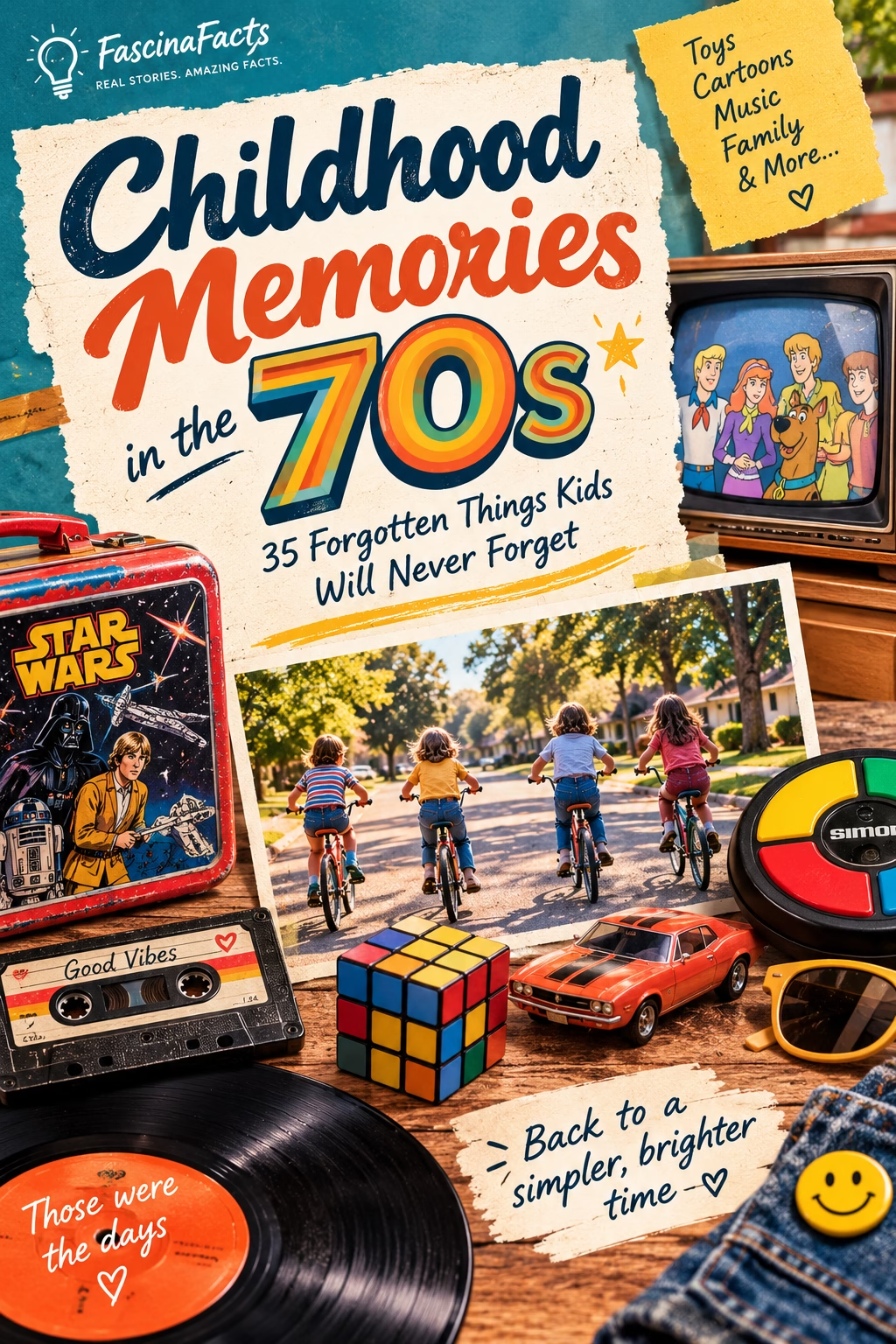
Summer meant long days outside
School holidays offered time to develop friendships and repeat favorite activities until they became rituals. Children might spend the morning building something, come home for lunch and disappear outside again after finishing their chores.
In some places, the sound of children playing outdoors gradually gave way to the familiar calls of parents announcing dinner. The end of the day was measured less by notifications than by sunlight, streetlights and family schedules.
3. Toys That Defined a Generation
The 1970s combined traditional toys with increasingly sophisticated products. Dolls, model cars and construction sets remained popular, while new electronic games and licensed characters transformed toy shops. Some toys became more than playthings: they reflected the decade’s fascination with space, science fiction, television and colorful design.
Star Wars action figures
After the first Star Wars film arrived in 1977, its characters helped create a new era of movie-related toys. Children could recreate space battles and invent adventures between films.
Stretch Armstrong
Introduced in 1976, the stretchy action figure fascinated children with its unusual elastic body and the challenge of pulling it into different shapes.
Lite-Brite
First introduced in 1967, this illuminated drawing toy remained a familiar favorite. Colored pegs turned a dark panel into glowing pictures.
Simon
Released in 1978, Simon challenged players to remember sequences of lights and sounds. It brought electronic memory games into more homes.
LEGO building sets
Plastic bricks encouraged children to construct houses, vehicles and imaginary worlds. A single collection could be dismantled and rebuilt endlessly.
Board games and puzzles
Family favorites such as Monopoly and other tabletop games created friendly rivalries, arguments over rules and memorable rainy afternoons.
The Rubik’s Cube: a famous case of mistaken timing
The Rubik’s Cube deserves a special mention, but its history is often compressed into one nostalgic memory. Hungarian architect Ernő Rubik developed the puzzle in 1974. It was initially marketed under the name Magic Cube, and its worldwide commercial explosion took place around the turn of the 1980s.
That distinction matters. Some people who remember growing up in the 1970s encountered the puzzle in the decade’s final years, while many others associate it more strongly with the 1980s. Nostalgia often blends neighboring decades into one continuous memory.
Why simple toys lasted
A toy did not need a screen to offer endless possibilities. Dolls could become characters in elaborate stories, model cars could form entire racing championships, and construction bricks could be transformed into a new creation every weekend.
Many toys also encouraged sharing. Children traded accessories, borrowed pieces, invented rules and learned to negotiate. The social experience surrounding a toy could be just as important as the object itself.
4. Television and the Magic of Saturday Morning
Television was one of the defining influences on popular childhood culture in the 1970s. It brought cartoons, educational programs, live sports, comedy and science-fiction adventures into family homes. In many American households, Saturday mornings became a special viewing ritual.
Children might wake early, settle in front of the television and watch animated programs before the rest of the day’s activities began. Commercials for toys, cereals and other children’s products were also part of the experience.
Programs that left a cultural footprint
- Scooby-Doo, Where Are You! — mysteries, comic scares and a group of friends solving strange cases.
- The Pink Panther Show — visual comedy that often worked without much dialogue.
- Super Friends — animated superhero adventures featuring familiar DC characters.
- Schoolhouse Rock! — short animated songs that helped teach topics such as grammar, mathematics and civics.
- Sesame Street — educational television that blended songs, humor and learning for young viewers.
- The Muppet Show — musical performances, comedy and memorable puppet characters enjoyed by different age groups.
Availability depended on the country, television network and year. A British child watching a particular program might have had a different schedule from an American child. Some households had color televisions, while others still watched programs in black and white.
When a television had to be shared
In a home with only one television, children did not necessarily control the remote. There might be no remote at all: changing the channel could require getting up and turning a physical dial.
Parents might prefer the news, a drama or a major sporting event. Children learned to wait, compromise or find something else to do. And when a program ended, the television schedule dictated what happened next.
Did you know? The first episode of Happy Days aired in 1974. The series later helped shape popular nostalgic images of American youth culture, even though much of its story looked back to the 1950s.
5. Music, Record Players and the Rise of the Cassette
Music was everywhere in the 1970s, but listening to it often involved a physical object. Records had sleeves to inspect, tapes had labels to write and radios brought a mixture of new releases, familiar songs and unexpected discoveries.
The decade included disco, hard rock, progressive rock, soul, funk, punk and singer-songwriter music. Children absorbed these sounds through parents, older siblings, radio broadcasts, films and the music playing in shops or cars.
How children listened to music
Vinyl records
Albums and singles came with artwork, printed information and a ritual of placing a record on a turntable. Scratches and careful handling were familiar concerns.
Portable radios
Transistor radios made it easier to listen away from the family stereo. A favorite song might appear unexpectedly while cycling, relaxing or traveling.
Cassette tapes
Compact cassettes made recorded music portable and helped people create collections of favorite tracks. Recording from the radio could require perfect timing.
Eight-track players
Eight-track cartridges were another format used in some home and car stereo systems, particularly in North America. Their popularity varied by market.
The excitement of recording a song
For children and teenagers with access to suitable equipment, recording music could become a small project. You might prepare a blank cassette, wait for the presenter to stop speaking and press the record button at precisely the right moment.
A carefully assembled mixtape could carry a personal meaning long before digital playlists existed. Some tapes were made for road trips; others were exchanged between friends or filled with songs associated with a particular summer.
Of course, not every family owned a cassette recorder, and recording technology was not equally accessible everywhere. But the expanding availability of compact cassettes during the 1970s helped change how people stored and shared music.
6. Everyday Life at Home: Small Details That Felt Ordinary
People rarely realize which everyday objects will eventually become nostalgic. A kitchen clock, a particular sofa pattern or a telephone beside the hallway may seem unremarkable when it is part of daily life. Years later, those same details can bring back a whole household.
The family telephone
Rotary telephones remained familiar in many homes, although push-button models were also available. A shared phone often meant that everyone could hear it ring, and a long conversation might occupy the line when another family member wanted to make a call.
Children sometimes memorized their friends’ telephone numbers. Calling someone could involve asking a parent for permission, waiting until an appropriate hour and speaking politely to the person who answered.
The living room as a family meeting place
In many households, the living room was where family members watched television, listened to music, played board games and entertained visitors. Furniture, wallpaper and decorations reflected a wide range of styles, including earthy colors, wood finishes, bold patterns and textured fabrics.
Some families had shag carpeting, large patterned curtains or brightly colored kitchen appliances. Others had simple furniture that had been used for years. The decade’s visual style was distinctive, but there was never one universal 1970s home.
Photography meant waiting for the pictures
Family photographs often involved a film camera and a roll of film that needed to be processed. You might wait days before discovering whether a picture was clear, whether someone had blinked or whether the camera had captured the moment you remembered.
Instant cameras offered a different experience. Polaroid photography could produce a physical image quickly, but film had a cost, so photographs were not always taken as casually as digital pictures are today.
Chores were part of the routine
Childhood was not simply endless play. Many children had household responsibilities such as tidying their rooms, helping with dishes, taking out rubbish or caring for younger siblings. Expectations varied widely according to family circumstances and cultural traditions.
Those routines helped shape how children understood responsibility, family cooperation and the boundaries between school, play and home life.
7. School Days: Chalk, Paper and Classroom Rituals
School in the 1970s was not identical everywhere, but many classrooms relied heavily on printed textbooks, notebooks, chalkboards and handwritten assignments. Teachers explained lessons at the front of the room, and pupils often copied notes or completed exercises by hand.
Objects that made the school day memorable
- Chalkboards: Teachers wrote explanations, dates and exercises for the entire class to see.
- Overhead projectors: Transparent sheets could display diagrams and notes on a screen or wall.
- Filmstrips: Educational images were shown in sequence, sometimes accompanied by recorded narration.
- Paper notebooks: Handwriting, corrections, doodles and carefully copied headings filled school exercise books.
- Library cards: Borrowing a book involved a physical lending system rather than a digital account.
- School bags and lunchboxes: Everyday objects could become personal favorites, especially when decorated with recognizable characters.
Calculators and other classroom technologies existed, but their use depended on school policy, subject, price and the year. Computers were not standard equipment in most ordinary classrooms in the early part of the decade.
Fashion was part of growing up
Bell-bottom trousers, flared jeans, corduroy, striped shirts, graphic T-shirts, denim jackets and colorful knitwear all appeared in 1970s fashion. Children followed trends in their own way, often mixing hand-me-down clothing with new items bought for school or special occasions.
Popular styles differed across countries and social groups. Some children wore uniforms, while others had more freedom to choose their clothes. Practicality, family budgets and school rules could matter more than fashion magazines.
Sports shoes, sandals and roller skates also reflected how children moved between school, home and outdoor activities. Clothing had to survive playgrounds, muddy paths and everyday wear, not just look good in photographs.
8. Lunchboxes, Snacks and Family Meals
Food memories are often surprisingly vivid. A familiar drink, a lunchbox opened at school or a special treat after a shopping trip can become a symbol of an entire childhood.
In the United States, some children carried lunchboxes decorated with television characters, superheroes or movie imagery. Others used plain containers or ate meals provided by their schools. In other countries, lunch traditions looked entirely different.
Snacks associated with the decade
Products such as Pop Rocks, Twinkies, Tang and various packaged sweets became part of American popular food culture. Their availability and popularity varied, and not every product was new to the 1970s.
- Pop Rocks: The fizzy candy became widely known during the 1970s and was famous for its unusual popping sensation.
- Tang: The powdered orange drink had already existed since the late 1950s and gained wider public recognition through its association with the American space program.
- Packaged cakes: Individually wrapped snacks were convenient for lunchboxes, picnics and trips.
- Homemade treats: Cookies, sandwiches, cakes and other family recipes remained important in many homes.
- Local favorites: Children around the world enjoyed sweets and snacks shaped by their own regional food traditions.
Family meals were another major part of daily life. Depending on the household, dinner might be a shared meal at a table, a quick dish after work or a more flexible arrangement around school and other commitments.
It is tempting to imagine every 1970s family sitting together at the same time each evening. In reality, work schedules, household income, family structures and local customs created many different routines.
9. Road Trips, Car Games and Summer Holidays
For many families, a long car journey was a major event. The destination might be a beach, a relative’s house, a national park or a holiday town. Children packed clothes, books, snacks and perhaps a favorite toy before squeezing into the back seat.
Without smartphone navigation and streaming entertainment, a trip could involve printed maps, road signs, radio programs and conversations about the route. Some cars had cassette or eight-track players, while others relied on radio broadcasts or simply the sound of the road.
How children passed the time
- Counting passing cars or searching for vehicles of a particular color.
- Playing word games and guessing games with siblings.
- Looking through paper maps to follow the journey.
- Reading books or comics until the movement made it difficult.
- Listening to music and asking how much longer remained.
- Watching the scenery change from towns to countryside and back again.
Stops at roadside restaurants, service stations and small shops could become memorable parts of the trip. So could the family arguments, the uncomfortable back seat and the excitement of finally seeing the destination.
A reminder about nostalgia: Car safety standards and habits were different in many places during the 1970s. Seat belts existed, but wearing them was not yet a consistent habit everywhere. Modern child restraints, seat belts and appropriate safety practices are essential today.
10. The Technology Revolution Was Already Beginning
It is easy to describe the 1970s as a world without technology, but that would miss one of the decade’s most interesting stories. Electronics, video games, calculators and home entertainment systems were changing rapidly. Most households did not have today’s connected devices, yet the foundations of modern digital life were taking shape.
Pong brings video games into the spotlight
Atari’s arcade version of Pong helped make electronic video games a popular commercial phenomenon. Its simple table-tennis concept was easy to understand and exciting to play.
The first commercially successful personal computer kits emerge
The Altair 8800 helped energize the early personal-computer movement. Such machines were very different from modern PCs and initially appealed mainly to electronics enthusiasts and hobbyists.
Home computing gains attention
Computers such as the Apple II and Commodore PET appeared in 1977. They helped establish a market that would expand considerably during the following decade.
Star Wars changes entertainment culture
The original film introduced a science-fiction universe that would influence cinema, toys, merchandising and generations of young fans.
Simon brings electronic memory games home
The light-and-sound game challenged players to repeat increasingly complex sequences. It was a sign of the growing appeal of interactive electronic toys.
These developments did not mean that every child suddenly had access to a computer or video game. Cost, location and household resources mattered enormously. For many families, the television remained the main electronic entertainment device throughout the decade.
Nevertheless, the late 1970s offered a glimpse of a future in which games could be played electronically, information could be processed by personal machines and entertainment would increasingly move beyond traditional broadcasting.
11. More Fascinating Facts About Childhood in the 1970s
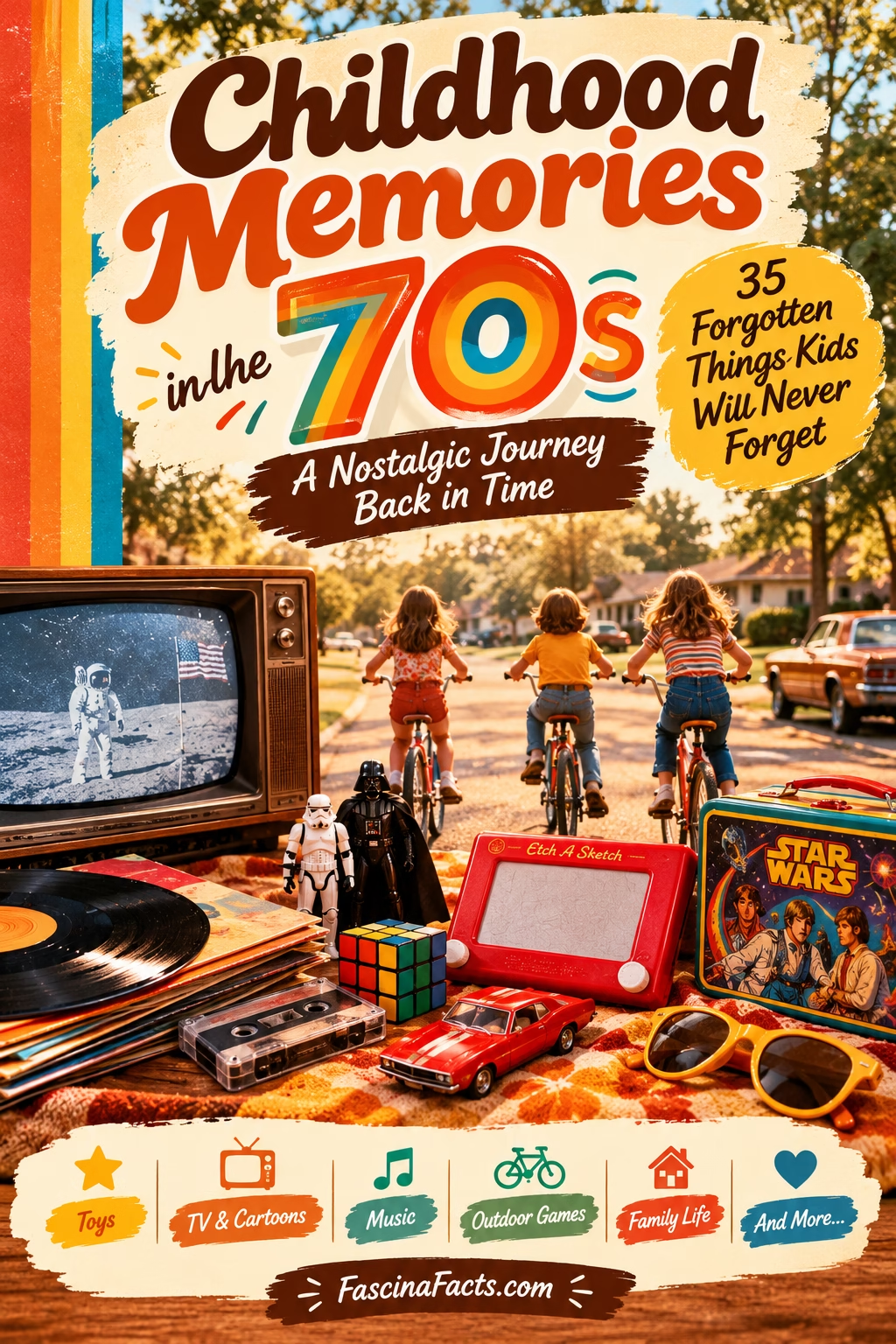
Here are additional details that help bring the decade to life. Some describe specific historical milestones, while others reflect common experiences in particular countries rather than universal rules.
Movie toys became cultural treasures
The success of Star Wars in 1977 helped demonstrate how characters from a film could inspire a major market for action figures and related merchandise.
Home video was still developing
Videocassette recorders existed during the decade, but they were expensive and far from universal. Recording television and watching movies at home became much more widespread later.
Music formats overlapped
Records, radio, eight-track cartridges and compact cassettes coexisted. The format people used depended on their equipment, location and budget.
Not all televisions showed color
Color broadcasting and color television ownership expanded over many years. Some households continued to use black-and-white sets during the 1970s.
Disco crossed generations
Dance music, fashion and nightclub culture influenced wider popular culture, including radio, films, television and the clothes worn by some young people.
Libraries opened imaginary worlds
Public libraries gave children access to books, reference material and stories beyond what their families could afford to buy.
Board games created family traditions
Games could bring siblings, parents and grandparents together. The rules were printed on paper, but the arguments about them were entirely personal.
Childhood varied around the world
Access to television, toys, transport and leisure time depended on local economies and family circumstances. There was no single global 1970s childhood.
12. Was Childhood in the 1970s Really Better?
It is tempting to compare the past with the present and conclude that one generation had a better childhood. But nostalgia can make ordinary days seem magical while quietly removing the difficulties that existed at the time.
What many people remember fondly
- Unstructured play: Children often had opportunities to invent games without an adult planning every minute.
- Face-to-face friendships: Time together was frequently spent talking, playing or sharing activities in person.
- Anticipation: Waiting for a program, a new record or a holiday could make the event feel especially exciting.
- Creative problem-solving: Limited equipment encouraged some children to improvise with whatever they had available.
- Shared entertainment: Family members often gathered around the same television, radio or board game.
What the nostalgic picture can leave out
- Safety concerns: Road safety, protective equipment and awareness of some risks were different from current practices.
- Limited access: Children without nearby friends, safe outdoor spaces or sufficient family resources had different experiences.
- Social inequalities: Discrimination and unequal opportunities affected children’s lives in many countries.
- Less immediate communication: Finding help, contacting family or sharing important information could take longer.
- Fewer entertainment choices: A limited number of television channels and expensive equipment constrained access to media.
Modern childhood has its own challenges, including excessive screen use, online pressures and the difficulty of balancing digital activities with physical play. At the same time, today’s children can access educational resources, communicate across long distances and explore creative interests in ways that were once impossible.
The most useful lesson from 1970s childhood is not that every aspect of the past was superior. It is that certain experiences remain valuable: playing outdoors, learning practical skills, sharing meals, spending time with friends and allowing room for boredom and imagination.
What We Can Bring Back Today
You do not need a vintage television or a collection of old toys to recreate the best parts of a 1970s afternoon.
Try organizing an outdoor game, building something from cardboard, playing a board game without phones nearby, visiting a library or listening to an album from beginning to end. Let children make up their own rules, solve small problems and turn ordinary objects into something extraordinary.
The goal is not to live in the past. It is to preserve the curiosity, connection and creativity that make childhood meaningful in every generation.
Frequently Asked Questions About Childhood in the 1970s
What did children do for fun in the 1970s?
Many children played outdoor games, rode bicycles, visited friends, read comics, built things, collected toys and watched television. Activities varied by age, location, family circumstances and access to recreational facilities.
What were the most popular toys of the 1970s?
Popular toys included LEGO building sets, dolls, model cars, action figures, Lite-Brite, Stretch Armstrong and electronic games such as Simon, released in 1978. Star Wars action figures became especially influential after the film premiered in 1977.
Did children have video games in the 1970s?
Yes. Arcade games such as Pong helped popularize video gaming early in the decade. Home video game systems also appeared, but ownership varied. Electronic gaming was not yet a standard part of every child’s life.
What television shows did children watch in the 1970s?
In the United States, popular children’s programs included Sesame Street, Scooby-Doo, The Pink Panther Show, Super Friends and Schoolhouse Rock! Viewing schedules differed by network, year and country.
How did children listen to music before digital streaming?
Children and families listened to broadcast radio, vinyl records and, increasingly, cassette tapes. Some households also used eight-track players. The equipment available depended on cost and local market preferences.
Did every family own a color television in the 1970s?
No. Color television had become well established in some markets, but not every household could afford a color set. Ownership and broadcasting development varied by country and region.
What made 1970s childhood different from childhood today?
Digital devices and internet access were not part of ordinary childhood. Entertainment was more dependent on broadcast schedules, physical media and in-person activities. However, experiences differed considerably, and the decade should not be treated as a single universal childhood.
What did children eat for snacks in the 1970s?
In the United States, packaged cakes, candy, sandwiches and drinks such as Tang were familiar to many families. Local snacks, homemade food and school meal traditions differed across the world.
When did the Rubik’s Cube become popular?
Ernő Rubik developed the puzzle in 1974, but its worldwide commercial success arrived around the turn of the 1980s. Its story is a good example of how memories of neighboring decades can overlap.
Why do people feel nostalgic about the 1970s?
Memories of childhood friendships, familiar songs, family rituals, favorite toys and important life events can create powerful nostalgia. People often remember the emotional meaning of these experiences as much as the objects themselves.
Final Thoughts: The Childhood Memories That Never Grow Old
Childhood in the 1970s was shaped by a distinctive mixture of familiar traditions and exciting new developments. Children still rode bicycles, played games and gathered with friends, while television, popular music, movie merchandise and emerging electronic entertainment steadily changed the world around them.
For those who lived through the decade, a single song, a toy catalog, a patterned sofa or the sound of a television program can bring back a remarkable number of memories. For younger readers, these details offer a glimpse into a time when entertainment was less connected but imagination was every bit as important.
History is not simply a list of inventions and dates. It is also the story of how people spent an ordinary afternoon, what made them laugh, what they collected and which small experiences became unforgettable.
Which 1970s Memory Takes You Back?
Was it the music playing in your parents’ living room, a favorite Saturday morning cartoon, your first bicycle, a beloved toy or a summer spent with neighborhood friends?
Share your favorite memory in the comments and help keep the stories of everyday childhood alive for the next generation.
Sources and Further Reading
Explore these historical and institutional resources for additional context on the toys, technology and popular culture mentioned in this article.
- The Museum of Modern Art (MoMA) — design, modern art and historical objects.
- Smithsonian National Museum of American History — American inventions, everyday objects and popular culture.
- Computer History Museum — early personal computers and the development of computing.
- Pong-Story — historical material about Pong and early video games; use alongside museum sources for research.
- Rubik’s official website — background on the puzzle and its history.
- Library of Congress — photographs, recordings, newspapers and historical collections.
Editorial note: Examples in this article primarily reflect American popular culture where specified. They should not be interpreted as universal experiences for every child in the 1970s. Historical dates are included where useful, and individual memories may reflect different years within the decade.
