
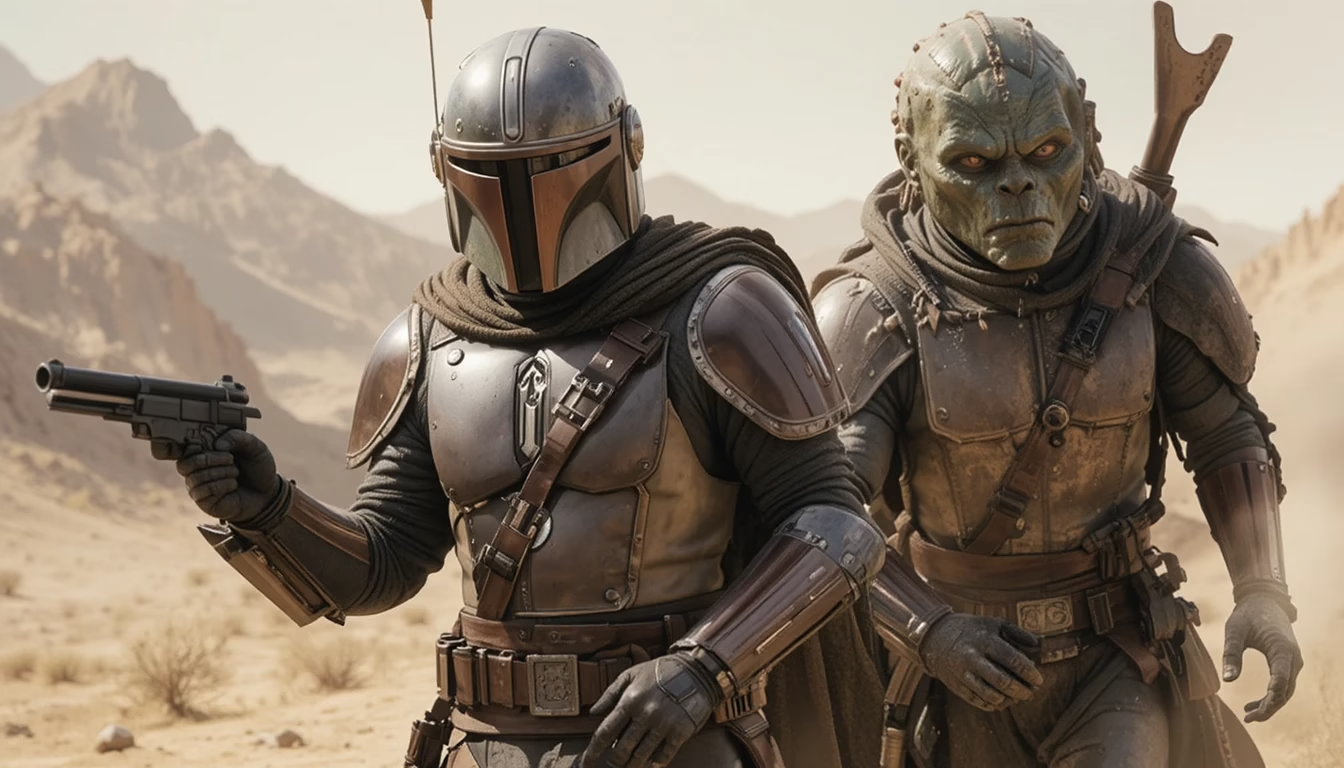
The galaxy far, far away is calling us back, not to our living rooms, but to the grandest stage of all: the silver screen. In a announcement that sent shockwaves through the Star Wars fandom, Lucasfilm and visionary director Jon Favreau revealed that the next chapter in the story of a lone bounty hunter and his enigmatic, force-sensitive ward will be a feature-length film. Titled The Mandalorian & Grogu, this cinematic event marks a monumental shift, bridging the gap between the record-breaking success of Disney+ television and the epic tradition of Star Wars theatrical releases.
This isn’t just another Star Wars movie. It’s the culmination of a story that captured our hearts, a story about clan, creed, and the unexpected bonds of family. It’s the next logical, and perhaps most ambitious, step for the series that redefined what Star Wars could be in a new era.
In this ultimate guide, we will dive deep into everything we know, everything we can speculate, and everything we hope to see when Din Djarin and Grogu stride onto the big screen in 2026. From confirmed production details and cast theories to plot predictions and the seismic impact this film will have on the future of the franchise, consider this your one-stop resource for all things related to The Mandalorian & Grogu.
Chapter 1: From Small Screen Phenomenon to Big Screen Epic: The Historic Announcement
The journey of The Mandalorian began in 2019, launching with the Disney+ streaming service and instantly becoming a global cultural touchstone. It wasn’t just the groundbreaking technology, the spaghetti-western tone, or the return to the franchise’s gritty roots. It was the introduction of “The Child,” affectionately known as Grogu, whose wide-eyed innocence and mysterious connection to the Force created a phenomenon dubbed “Mandalorian Mania.”
For three seasons, we followed Din Djarin’s journey from a solitary bounty hunter bound by the strict code of his Mandalorian creed to a surrogate father who would tear the galaxy apart to protect his foundling. The series finale of Season 3, “The Return,” provided a sense of closure and a new beginning. Din Djarin, now redeemed in the eyes of his tribe and having helped Bo-Katan Kryze reclaim Mandalore, officially adopts Grogu as his apprentice and son. He retires to a quiet life on Nevarro, taking on small-time bounties to support his new family while acting as an unofficial agent for the New Republic.
It felt like a happy ending. But in Star Wars, peace is a fleeting illusion.
The Groundbreaking Announcement
In early 2024, the news broke. Jon Favreau, the creative mastermind behind the series, would be making his directorial debut in the Star Wars feature film universe by helming The Mandalorian & Grogu. The film was announced as being in active pre-production and would be the next Star Wars theatrical release, boldly skipping the lengthy development and “in-production” phases that have characterized other announced projects.
Kathleen Kennedy, President of Lucasfilm, stated, “Jon Favreau and Dave Filoni have ushered in a new era of Star Wars storytelling, and we are thrilled to be bringing their work to the big screen. The Mandalorian & Grogu is a perfect culmination of their journey, and we can’t wait for fans to experience this new chapter in theaters.”
This move is strategic and symbolic. It signals that Lucasfilm views the story of Din Djarin and Grogu as being of the same epic importance as the Skywalker Saga itself. It is a validation of the characters’ immense popularity and a promise that their next adventure will be their most significant yet.
Chapter 2: The Creative Forces: The People Behind the Helmet
The success of The Mandalorian is inextricably linked to the visionary minds who built its world. The film brings this core team back together, now operating on a larger canvas with a bigger budget and the full resources of a theatrical production.
Jon Favreau: The Showrunner and Now, Feature Director
Jon Favreau’s role in the modern Star Wars renaissance cannot be overstated. As the executive producer, head writer, and showrunner of The Mandalorian, he was the architect who restored fan faith after the sequel trilogy. His deep understanding of classic genre filmmaking—the westerns of Sergio Leone, the samurai films of Akira Kurosawa—allowed him to strip Star Wars back to its essential, mythological roots.
Favreau is also no stranger to blockbuster filmmaking. He directed the first-ever MCU film, Iron Man (2008), proving his ability to launch a beloved franchise with character-driven storytelling and practical effects. His direction of The Jungle Book (2016) and The Lion King (2019) showcased a pioneering mastery of virtual production and photorealistic CGI—technology that would become the backbone of The Mandalorian’s “Volume” soundstage. Directing this film is a homecoming and a graduation for Favreau, allowing him to apply his unique skillset to a feature-length story he has nurtured from the beginning.
Dave Filoni: The Keeper of the Lore
If Favreau is the heart of The Mandalorian, Dave Filoni is its soul. A protege of George Lucas himself, Filoni has been the guiding light of Star Wars animation, creating The Clone Wars and Rebels, which have become essential pillars of the franchise’s lore. As an executive producer and frequent director on The Mandalorian, Filoni ensures that every story beat, every new planet, and every legacy character (like Ahsoka Tano and Captain Rex) feels authentically woven into the wider Star Wars tapestry.
His promotion to Chief Creative Officer at Lucasfilm underscores his importance. For the film, his role will be crucial in navigating the complex political landscape of the New Republic era and ensuring the story dovetails with other upcoming projects, including his own New Republic era-capping film.
The Power of Legacy: Ludwig Göransson’s Score and the Visual Pioneers
While not officially confirmed, it is all but certain that Oscar-winning composer Ludwig Göransson will return to score the film. His iconic theme for The Mandalorian—a haunting, tribal, and heroic piece—is as integral to the show’s identity as the Beskar armor itself. Translating that sound for a cinematic soundscape will be a thrilling prospect.
Furthermore, the groundbreaking work of the visual effects team, led by Richard Bluff, and the use of Industrial Light & Magic’s (ILM) StageCraft technology (the “Volume”) will be elevated. The film’s budget will allow for even more elaborate virtual environments, larger-scale practical effects, and seamless CGI, creating a visual experience that is both immersive and epic in a way only a big-screen movie can deliver.
Chapter 3: The Cast: Who Will Return to the Galaxy?
While official casting announcements are still to come, we can make highly educated guesses about who will be suiting up for the big screen.
The Core Duo: The Unbreakable Bond
- Pedro Pascal as Din Djarin / The Mandalorian: This is a definitive lock. Pascal’s portrayal, both vocally and physically (aided by stunt doubles Brendan Wayne and Lateef Crowder), has defined the character. While his face is rarely seen, his voice carries the weight, conflict, and growing warmth of a man learning to be more than a warrior. The film will live and die on his performance.
- Grogu: The star of the show will, of course, be back. Brought to life through a masterful combination of puppetry from the legendary Legacy Effects and CGI, Grogu’s role is expected to be more active than ever. The big question is: will he speak? His training with Luke Skywalker has undoubtedly unlocked more of his abilities, and the film may be the moment he finally says more than a coo or a giggle.
The Supporting Tribe: Friends and Foes
- Carl Weathers as Greef Karga: The leader of the Bounty Hunters’ Guild and High Magistrate of Nevarro has become a steadfast ally. Weathers’ charismatic presence is a staple of the series, and his planet provides a key home base for the duo.
- Giancarlo Esposito as Moff Gideon: While he appeared to perish in the finale of Season 3, in a universe with cloning and the dark sciences of the Force, no death is certain until it’s certain. Esposito’s chilling performance as the fanatical Imperial warlord is too good to leave behind permanently. Could the film introduce a clone? Or was his destruction of his own base a ruse?
- Emily Swallow as The Armorer: The enigmatic leader of the Mandalorian covert, whose wisdom and hammer have guided Din Djarin’s path. Her role in a unified Mandalore will be critical, and her knowledge of Mandalorian lore could be the key to a new threat.
- Potential Returns: It’s highly plausible we’ll see Katee Sackhoff as Bo-Katan Kryze, the ruler of Mandalore, and even Paul Sun-Hyung Lee as Captain Carson Teva, the New Republic pilot who has been a friendly face in the Outer Rim.
New Players and Legacy Cameos
A film of this magnitude will undoubtedly introduce new, high-profile characters as both allies and antagonists. Furthermore, the setting—roughly 12 years after Return of the Jedi—places it in a fertile narrative period. Could we see a young Jedi-in-training Rey? Or a mention of the rising threat of the First Order? The film will also need a primary antagonist, potentially a new Imperial remnant leader or a completely new threat from the Unknown Regions.
Chapter 4: Plot Theories and Speculation: What Dangers Await in the Unknown?
The official logline for the film is deliberately vague, simply promising to continue the adventures of the duo. However, by analyzing the threads left dangling from the series and the established lore of the Star Wars galaxy, we can theorize several compelling directions for the plot.
Theory 1: The Imperial Shadow – Thrawn and the Grysk
The most prominent theory connects directly to the events of Ahsoka and the upcoming New Republic film. Grand Admiral Thrawn has returned from exile and is marshaling the Imperial remnants into a formidable force. Dave Filoni’s overarching “Mandoverse” storyline seems to be building towards a massive conflict, and Din Djarin and Grogu are inevitably going to be pulled into it.
Thrawn’s return is often linked to a potential, even greater threat: the Grysk, a vicious, expansionist species from the Unknown Regions from Timothy Zahn’s novels. Din Djarin, with his unique skills and his powerful Force-sensitive son, could become a key asset in a galactic cold war that is about to turn hot. The film could serve as the catalyst for this larger conflict, with our heroes stumbling upon the vanguard of a Grysk invasion.
Theory 2: The Jedi Question – A New Path for Grogu
Grogu’s training is incomplete. He chose the path of the Mandalorian with his father over the path of the Jedi with Luke Skywalker. But the Force is not so easily denied. The film will almost certainly explore Grogu’s burgeoning abilities in greater depth. Could he be targeted by a dark side user seeking to exploit his power? We know other Force-wielding factions exist, like the Nightsisters of Dathomir. An antagonist like Morgan Elsbeth or a new dark side acolyte could see Grogu as the ultimate prize.
This storyline could also involve a search for a new, less dogmatic way to practice the Jedi arts. Perhaps Din Djarin will seek out Ahsoka Tano for guidance, creating a powerful trio to defend the galaxy. The film’s title, The Mandalorian & Grogu, powerfully suggests their fates are intertwined—Grogu may not be a traditional Jedi, but a Mandalorian foundling who wields the Force, a truly unique being in the galaxy.
Theory 3: The Legacy of Mandalore – Uniting the Clans
While Mandalore has been reclaimed, its future is fragile. The planet is a desolate wasteland, and the various Mandalorian clans have a long history of in-fighting. The film could introduce an internal threat—a radical Mandalorian faction, like the Death Watch, resurfacing with a more extremist ideology that clashes with Bo-Katan’s leadership and Din Djarin’s more honorable code.
This internal conflict would force Din Djarin to choose between his peaceful life and his duty to his people. It would be a powerful thematic continuation of his arc about defining what it truly means to “walk the Way.” The Darksaber may be destroyed, but the symbol of leadership it represented is still up for grabs.
The Most Likely Scenario: A Convergence of Threats
The most compelling narrative would weave these threads together. The film could begin with a localized threat on Nevarro or in Mandalorian space, only to reveal that it is a precursor to Thrawn’s larger strategy. Din and Grogu, trying to live a simple life, would be thrust back into the galactic spotlight, becoming the unlikely linchpins in a struggle that will define the future of the New Republic.
Chapter 5: The Cinematic Experience: Why Theaters Will Make All the Difference
Moving from television to film is not merely a change in distribution; it’s a fundamental shift in scope, scale, and storytelling language.
The Scale of Spectacle
The Mandalorian has always been a visually stunning show, but the constraints of a television budget and schedule are real. A feature film budget, likely in the $200 million range, allows for:
- Larger Set Pieces: Imagine a Mandalorian dogfight with dozens of TIE Fighters and Gauntlet starfighters on a massive IMAX screen. Or a ground battle with hundreds of Mandalorian warriors descending upon an Imperial fortress.
- More Exotic Locations: The “Volume” technology will be pushed to its limits, creating vistas and environments of unprecedented scale and detail. We could visit iconic planets from the lore in ways we’ve never seen before.
- Enhanced Creature Design: New, terrifying, and awe-inspiring creatures can be brought to life with more screen time and detail, harkening back to the practical effects magic of the original trilogy.
The Sound of a Galaxy
Ludwig Göransson’s score will be mixed for a state-of-the-art theatrical sound system. The roar of the Razor Crest’s replacement ship, the hum of the Darksaber, the subtle clicks and whirs of Grogu’s pod, and the epic sweep of the main theme will be an auditory experience that simply cannot be replicated at home. Sound is half of the cinematic experience, and this film promises to be a sonic feast.
The Cultural Event
Watching The Mandalorian & Grogu in a theater, surrounded by fans, is an event. The collective gasp at a surprise reveal, the laughter at one of Grogu’s antics, and the applause as the title card flashes—this shared experience is a core part of the Star Wars magic that has been dormant since the sequel trilogy concluded. It transforms the viewing from a passive activity into a communal celebration of fandom.
Chapter 6: The Ripple Effect: How This Film Shapes the Future of Star Wars
The Mandalorian & Grogu is not an isolated project. It is the cornerstone of Lucasfilm’s new theatrical strategy and the likely catalyst for the next decade of Star Wars storytelling.
Paving the Way for the “Mandoverse” Crossover Event
As mentioned, Dave Filoni is working on his own film, which has been described as a culmination of the stories told in The Mandalorian, The Book of Boba Fett, Ahsoka, and the upcoming Skeleton Crew. It is expected to be a large-scale clash between the New Republic and Thrawn’s forces. The Mandalorian & Grogu will almost certainly serve as the direct narrative precursor to this event. The actions of Din Djarin and Grogu in their film will likely be the spark that ignites the wider conflict, setting the stage for Filoni’s Avengers-style crossover.
A New Model for Franchise Storytelling
The success of this film could redefine how studios approach interconnected universes. It demonstrates a fluidity between television and film, allowing characters to grow and develop over multiple seasons of a show before graduating to a blockbuster movie. This “soft reboot” of the Star Wars film slate, built on the back of a beloved and established property, is a less risky and more fan-friendly approach than launching an entirely new saga from scratch.
The Future of the Duo
What does this film mean for the future of Din Djarin and Grogu? It could serve as a definitive finale to their story, allowing them to ride off into the sunset once and for all. Alternatively, it could launch a new film series, with subsequent movies following their further adventures. It could also see the characters splintering off, with Grogu potentially getting his own spin-off as he grows into his powers. The possibilities are endless, but it all starts with the success and direction of this first, landmark film.
Conclusion: The Wait for 2026 – A New Hope for the Big Screen
The announcement of The Mandalorian & Grogu is more than just news of another movie; it’s a promise. A promise of a return to the foundational spirit of Star Wars—mythic storytelling, practical artistry, and characters we care deeply about. It’s a promise that the journey we began in 2019, in the dusty cantinas of the Outer Rim, was only the beginning.
Jon Favreau, Dave Filoni, and their incredible team have earned our trust. They have shown a profound respect for the source material while boldly charting a new course. Taking Din Djarin and Grogu to the big screen is the ultimate test of their vision, and all signs point to it being a resounding success.
As we count down the days to 2026, the anticipation will be galactic. We will scour every piece of news, analyze every teaser trailer, and theorize endlessly about the fates of our favorite armored father and his adorable, powerful son. One thing is certain: the Force is strong with this one. The path of the Mandalorian is leading to the theater, and we will all be there to witness it.
What are you most hoping to see in The Mandalorian & Grogu? Share your biggest theories and wishes in the comments below!