
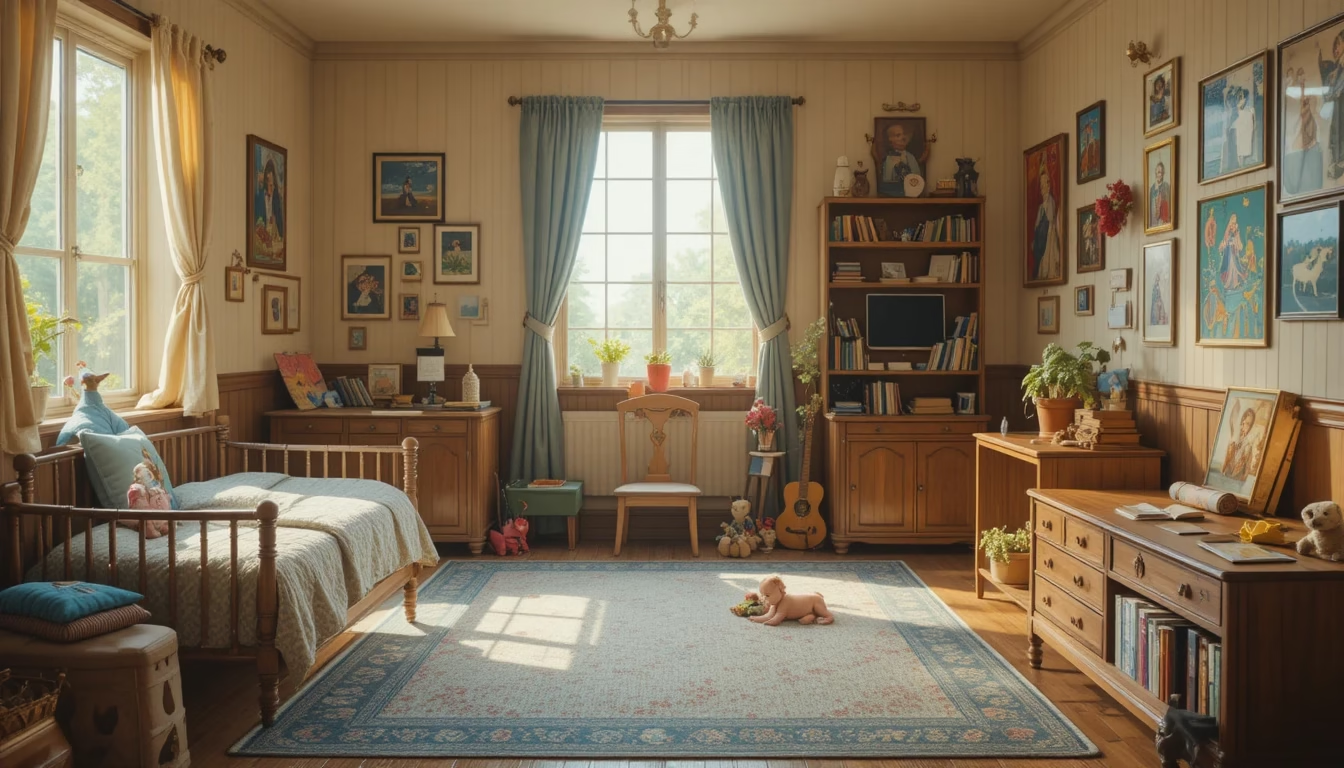
Meta Description: Immerse yourself in a comprehensive 2,500+ word exploration of 1970s childhood. From the scent of ditto sheets to the freedom of a Schwinn Sting-Ray, we unpack the cultural, social, and emotional fabric of a generation raised in a pre-digital wonderland.
URL Slug: 1970s-childhood-memories-nostalgia-complete-guide
Focus Keyphrase: 1970s childhood memories
Prologue: A Dial-Up World, Literally and Figuratively
Imagine a world not in your pocket, but all around you. A world where information traveled at the speed of a bicycle tire, connection meant a knock on a screen door, and entertainment was something you built, not buffered. This was the landscape of a 1970s childhood—a decade suspended between the profound social upheavals of the 60s and the tech-centric consumerism of the 80s.
For the children of the seventies, life was a vivid, tactile, and paradoxically free experience. It was the last generation to grow up entirely analog, making their memories a precious cultural artifact. This isn’t just a nostalgic list; it’s an anthropological study of a disappearing childhood paradigm. Let’s embark on a detailed odyssey through the sights, sounds, textures, and, most importantly, the feeling of being a kid in this unforgettable era.
Part 1: The Geography of Freedom – The Unsupervised Playground
The most defining and enduring memory for any 70s kid is the sheer, unadulterated autonomy. Parental philosophy could be summarized as: “Go outside and don’t come back until dinner.” This wasn’t neglect; it was a societal trust in the neighborhood as a safe ecosystem.
The Great Outdoor Commandments:
- The Streetlight Curfew: The universal signal. The moment those orange-hued glows flickered on, a wave of kids would disperse towards home like bats sensing dusk.
- The Bike as a Spaceship: Your bicycle was your passport. A Schwinn Sting-Ray with a banana seat and sissy bar wasn’t just a bike; it was a chopper, a race car, a steed. You customized it with spoke beads, a license plate from a road trip, and a playing card clothes-pinned to the frame for that glorious motor-like brrrrrr. Helmets? Unheard of. The wind in your hair was a right of passage.
- The Terrain: Every neighborhood had its landmarks. The Woods (a patch of trees that felt like an endless forest), The Vacant Lot (a kingdom of weeds, broken glass, and possibility), The Creek (for catching tadpoles or daring each other to cross), and The Spooky House (its story elaborated upon with each telling).
- The Social Contract: Play was negotiated in real-time. You solved disputes without adult arbitration. Hierarchy was established by skill (the best kickball pitcher), bravery (who would retrieve the ball from Old Man Jenkins’ yard), or ownership (who had the best GI Joe aircraft carrier).
Part 2: The Sonic Tapestry – AM Radio, Vinyl, and the TV Theme Song Symphony
Sound shaped the decade’s soul. It was shared, anticipated, and physically interacted with.
The AM Radio Galaxy: Before algorithms, music discovery was a ritual. You’d huddle around a transistor radio, its telescopic antenna extended, searching for the crackly signal of the top 40 station. Recording a song onto a cassette tape required surgeon-like precision—hitting ‘record’ and ‘play’ simultaneously the second the DJ stopped talking, and holding your breath so the tape wouldn’t capture your breathing. The soundtrack was wildly eclectic: the glam rock of David Bowie and T. Rex, the California soft rock of The Eagles, the raw energy of KISS, the storytelling of Harry Chapin, and the disco inferno ignited by Donna Summer and the Bee Gees.
The Vinyl Ritual: An album was an event. You saved your allowance, rode your bike to the record store, and spent hours flipping through bins. The 12-inch sleeve was a portal. You’d stare at the intricate artwork of Jimi Hendrix’s Axis: Bold as Love or the dystopian landscape of Yes’s Fragile. You’d read every lyric, credit, and thank-you note. The act of placing the needle on the groove was a moment of reverence, followed by the warm, sometimes dusty, crackle before the music began.
The Television as a Cultural Hearth: TV was a scheduled, communal activity. You planned your week around it.
- Saturday Morning Cartoon Marathon: A sugar-fueled ritual. From the environmental messages of “The Smurfs” to the anarchic chaos of “Tom & Jerry,” and the superhero ethics of “Super Friends.” The breaks were filled with unforgettable commercials for Sea-Monkeys, Mr. Microphone, and Quisp cereal.
- After-School Sanctuary: The Brady Bunch, Gilligan’s Island, Happy Days. These shows presented a world of solvable problems and clear morals.
- The “Very Special Episode”: Dramatized in After-School Specials and woven into sitcoms like Different Strokes and One Day at a Time. They tackled drugs, divorce, and stranger danger with a heavy-handed sincerity that was the era’s version of a public service announcement.
Part 3: The Tactile World – Toys, Tech, and Tangible Things
Play was physical. Toys required imagination to animate them. Technology was something you could take apart.
The Golden Age of Toys:
- Action Figures & Dolls: GI Joe (with kung-fu grip and eagle eyes), Star Wars figures (the holy grail after 1977), Barbie’s Camper, and The Six Million Dollar Man with his bionic eye you could peer through. Accessories were as important as the figures themselves.
- Creative Kits: Creepy Crawlers with its hot, smelly Thingmaker. Lite-Brite, transforming a dark room with colored pegs of light. Shrinky Dinks, magical plastic that curled and flattened into tiny charms.
- Board Games & Puzzles: Family game night meant fierce competition over Sorry!, Operation (with its nerve-wracking buzzer), Mastermind, and the epic, friendship-testing Risk. Jigsaw puzzles, often of serene landscapes or kittens, were a winter weekend staple.
Analog Tech Wonders:
- The Family Camera: A Kodak Instamatic with a cube flash. Film was finite (24 exposures), developing took a week, and half the photos were blurry or had a thumb in the corner. The anticipation of getting the photo envelope back from the drugstore was immense.
- The Console Stereo: A massive piece of furniture housing a turntable, 8-track player, and AM/FM radio. It was the centerpiece of the living room.
- Pong & the Atari 2600: The dawn of video games. The simple, hypnotic beep-boop of Pong (1975) was revolutionary. By the end of the decade, the Atari 2600 brought Space Invaders and Adventure into the home, forever changing the play landscape.
Part 4: The Sensation of Style – A Polyester Panorama
70s kids’ fashion was a glorious, unselfconscious explosion of synthetic fabrics, bold patterns, and practical durability.
The Uniforms of Play:
- Jeans: Levi’s cords or Sears Toughskins—jeans literally guaranteed to outlast the kid wearing them, with reinforced knees that became stiff as cardboard.
- Footwear: PF Flyers (promising speed), Converse All-Stars, Candies for girls, and in winter, moon boots that made you feel like an astronaut.
- The Winter Wear: The dreaded snowmobile suit—a giant, puffy, one-piece monstrosity that rendered you immobile but warm. Once you fell over, you were often stuck like a turtle on its back.
- Rainy Day Gear: The vinyl slicker with the sharp, chemical smell and matching hat.
The Dress-Up Culture:
- For Parties/Growing Up: Gunne Sax dresses (inspired by prairie life), leisure suits for boys (a miniature version of Dad’s), polyester shirts with wide, pointy collars, and platform shoes that added inches and peril.
- The Hair: Long, center-parted hair for both genders. Feathered wings (thanks to Farrah Fawcett), afros, and the short, sleek Dorothy Hamill wedge were iconic styles. Accessories included butterfly clips, macramé headbands, and mood rings.
Part 5: The Flavor Matrix – A Culinary Journey of Sugar, Salt, and Convenience
70s kid cuisine was a product of post-war convenience culture and unchecked food marketing.
The Breakfast of Champions:
- Cereal: Aisle of psychedelic colors and cartoon mascots. Count Chocula, Franken Berry, Cap’n Crunch (which scraped the roof of your mouth), Lucky Charms. The prize in the box was often more exciting than the cereal itself.
- The Drink Cabinet: Tang (the space-age powder), Hi-C Ecto Cooler, Kool-Aid made with a full cup of sugar, and for a “healthy” option, Yoo-hoo.
Lunchbox Archeology:
- The Metal Lunchbox: A cultural signifier. You carried your favorite show—Star Wars, Charlie’s Angels, The Six Million Dollar Man—to school. Inside: a thermos that usually leaked, a PB&J on Wonder Bread, Hostess Fruit Pies (the original, before they were “mini”), and a piece of fruit that often came back home bruised.
Dinner Time Traditions:
- The Swanson TV Dinner: In its iconic aluminum tray, compartmentalized with turkey, corn, mashed potatoes, and a brownie. Eating in front of the TV on a TV tray was a thrilling break from routine.
- Casserole Culture: Tuna noodle casserole topped with potato chips, green bean casserole (a Thanksgiving staple born from Campbell’s soup marketing), Hamburger Helper.
- The Rise of Fast Food: A treat, not a routine. McDonald’s golden arches were a beacon of joy. The Burger King crown, the Pizza Hut red roof and pan pizza, and the Dairy Queen dipped cone were landmarks of childhood bliss.
Part 6: The Cultural Milestones – The News That Seeped Through
While largely protected, kids absorbed the decade’s events through a filter of parental anxiety and pop culture.
- The Bicentennial (1976): A year-long red, white, and blue party. Schools were factories for construction-paper tricorn hats. Everything was branded with the 1776-1976 logo. It fostered a palpable, if simplistic, sense of national pride.
- The Space Age Finale & The Rise of Sci-Fi: The Apollo-Soyuz handshake (1975) felt like the end of an era. But then Star Wars (1977) exploded, re-igniting space fantasy and becoming a total lifestyle, from bed sheets to lunchboxes. Close Encounters of the Third Kind made the sky seem mysterious again.
- The Energy Crisis (1973, 1979): Even kids understood the odd/even license plate gas rationing and the lines at stations. It introduced concepts of scarcity and global politics.
- The Terrorism at the Olympics (1972): A dark shadow, often glimpsed through worried adult whispers and the somber tone of news anchor Walter Cronkite.
Part 7: The Psychological Legacy – What This Childhood Forged
The 70s childhood was a developmental petri dish that created a specific type of adult resilience.
- Mastery of Boredom: With no on-demand entertainment, you learned to sit with stillness. Staring at clouds, listening to records, or simply daydreaming were cultivated skills. Boredom was the mother of invention.
- Negotiation and Conflict Resolution: You had to work it out. Whether it was whose turn it was for the swing or the rules of a makeshift game, adult intervention was a last resort. This built social confidence and emotional intelligence.
- Risk Assessment and Consequence: You fell out of trees. You got into scrapes. You learned firsthand about physical limits and cause and effect in a low-stakes, high-freedom environment.
- Delayed Gratification: You waited for everything: TV shows, movie releases, mail-order toys (6-8 weeks for delivery!), film development. This built patience and amplified the joy of the eventual reward.
- A Sense of Collective Identity: Watching the same shows, playing the same games, and hearing the same songs created a powerful, shared cultural language. You were part of a tribe defined not by online niches, but by a common, real-world experience.
Epilogue: The Analog Echo in a Digital World
Today, the world of the 70s kid seems like a foreign country. Yet, its legacy is experiencing a renaissance. We see it in the vinyl revival, the popularity of escape rooms (collaborative, analog puzzles), the maker movement, and the conscious effort by many parents to enact “screen-free” time.
The 70s childhood offers a powerful counter-narrative to the curated, optimized, and monitored childhood of today. It reminds us that creativity is born from constraint, that resilience is built through skinned knees, and that the most profound connections are often made face-to-face in a treehouse, not screen-to-screen in a chat room.
To remember a 70s childhood is not to yearn for a perfect past—it had its own problems and perils—but to acknowledge the value of a different developmental path. It was a path of open skies, dirty hands, and the profound, unshakeable belief that as long as you were home before the streetlights came on, the day was yours to invent.
So, dust off that View-Master, dig out your 45s, and maybe go fly a kite. The spirit of ’77 isn’t gone; it’s just waiting for us to log off and tap back into the simple, analog magic of being present in a wide-open world.
What’s Your Story? The 70s were a vast, diverse experience. Were you a city kid navigating concrete playgrounds, or a rural kid with endless fields? Did you live for Saturday cartoons or spend every day at the local pool? Share your unique 70s childhood memory in the comments—let’s build this time capsule together.