
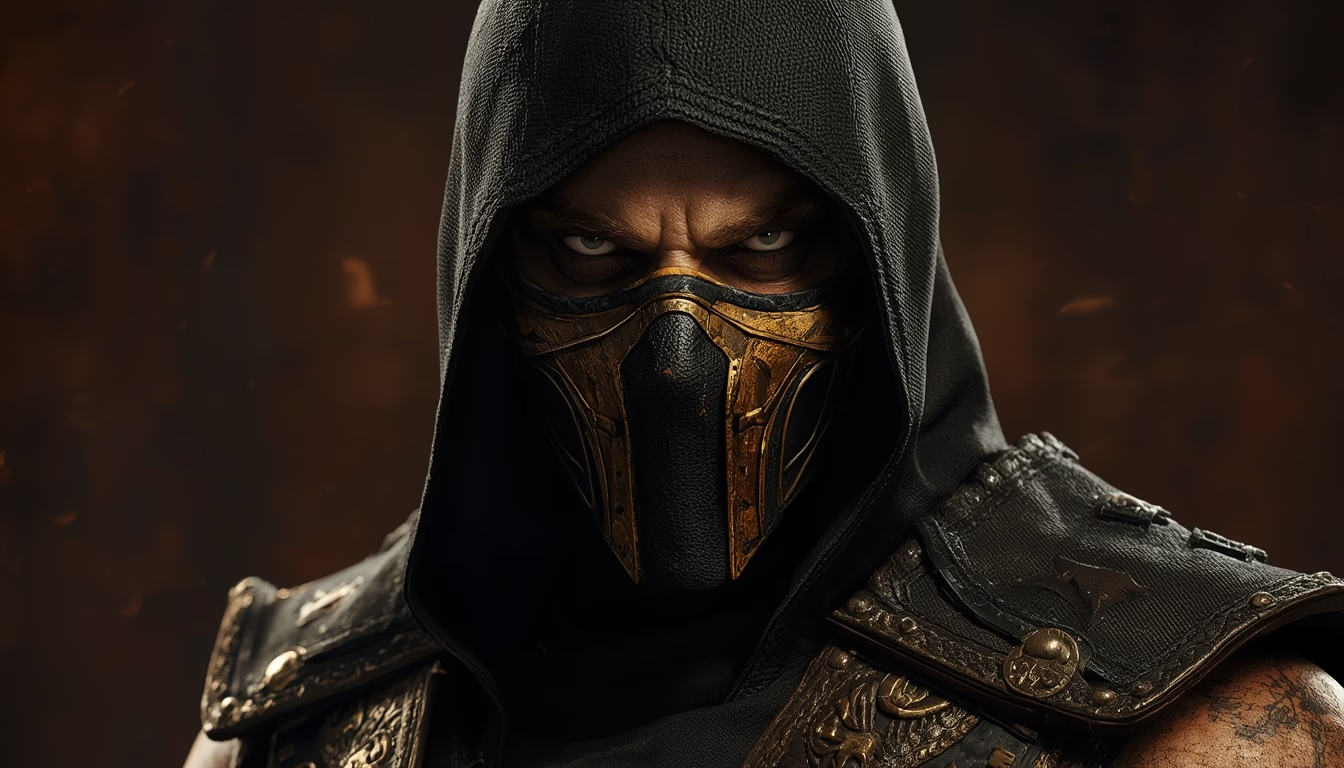

When you hear the name “Mortal Kombat,” you probably picture blood‑splattered arenas, iconic catchphrases, and a roster of fighters that have become pop‑culture legends. From its humble arcade beginnings in 1992 to the latest blockbuster film, the franchise has never stopped delivering adrenaline‑pumping action. In this post we’ll dive deep into the world of Mortal Kombat, spotlighting fan‑favorite characters like Scorpion, Sub‑Zero, Raiden, Liu Kang, and the often‑overlooked Kabal, while breaking down the newest movie’s storyline, visual style, and how it stacks up against the games we love.
From Arcade Cabinets to Global Phenomenon
The original Mortal Kombat was a revolutionary fighting game created by Ed Boon and John Tobias. Its gritty graphics, digitized sprites, and the infamous “Fatalities” set it apart from the cartoonish fare of the early ’90s. The game’s success sparked sequels, spin‑offs, and a massive merchandising wave that included action figures, comic books, and even a Saturday morning cartoon.
What made the series stand out wasn’t just the gore—it was the deep lore. The tournament’s premise—earth’s champions battling interdimensional warriors to prevent a conquest—gave writers a playground for mythic storytelling. Over the years, the narrative expanded to include realms like Outworld, Edenia, and the Netherrealm, each introducing new heroes and villains.
The Evolution Into Film
Hollywood first tried to capture the chaos in 1995’s Mortal Kombat directed by Paul W.S. Anderson. While the film’s special effects look dated by today’s standards, it succeeded in translating the game’s iconic moves and brutal finishers to the big screen. The sequel, Mortal Kombat: Annihilation (1997), attempted to up the stakes but suffered from a rushed script and uneven pacing.
Fast forward to 2021, the franchise rebooted with a fresh take that blended modern CGI with practical effects. This new movie aimed to please both die‑hard fans and newcomers, delivering a darker tone and a more coherent storyline that finally gave characters like Kabal the screen time they deserved.
Key Characters Who Define the Kombat Universe
Scorpion – The Vengeful Specter
Hanzo Hasashi, better known as Scorpion, is the embodiment of revenge. After his clan’s massacre, he returns from the Netherrealm wielding a flaming spear and the signature “Get Over Here!” line. His rivalry with Sub‑Zero remains one of the franchise’s most compelling dynamics.
Sub‑Zero – The Ice‑Cold Warrior
There are actually two Sub‑Zeros—Bi‑Han, the original, and his younger brother Kuai Liang, who took up the mantle after Bi‑Han’s death. Both wield cryogenic powers that freeze opponents, creating a perfect foil for Scorpion’s fire‑based attacks.
Raiden – The Thunder God
As Earthrealm’s protector, Raiding (the thunder god) serves as both mentor and combatant. His ability to summon lightning and teleport makes him a versatile fighter, while his moral compass guides the heroes through the darkest battles.
Liu Kang – The Champion of Earthrealm
Liu Kang’s journey from a Shaolin monk to the champion of the tournament is the heart of the series. Known for his blazing kicks and dragon fire, Liu Kang’s destiny is intertwined with the fate of Earthrealm, especially in the recent film where he confronts his own legacy.
Kabal – The Speed‑Driven Outlaw
Often eclipsed by the more famous fighters, Kabal brings a unique blend of speed and technology. A former Black Dragon member, Kabal lost his legs in a tragic accident and now relies on a pair of cybernetic respirators and a hook‑spear to zip across the battlefield. In the latest movie, Kabal’s backstory is explored in a gritty flashback, showcasing his transformation from a street‑level enforcer to a feared mercenary. His signature “Kabal’s Hook” move—an electrified spear that can pierce through multiple foes—adds a fresh tactical element to the fight choreography.
The Latest Movie: Plot, Action, and Visuals
The newest Mortal Kombat film opens with a brutal raid on a secret Outworld laboratory, where a rogue faction attempts to weaponize the Kombat crystals. Liu Kang, now a seasoned veteran, leads a team that includes Raiden, Sonya Blade, and the newly introduced Kabal. Their mission: retrieve the crystals before the sorcerer Shang Tsung can unleash a cataclysmic portal.
Mid‑movie, the narrative shifts to a high‑stakes tournament in the Netherrealm, echoing the classic game’s structure. Scorpion and Sub‑Zero find themselves on opposing sides, their personal vendetta taking center stage while the larger conflict looms. Kabal’s subplot reveals his betrayal of the Black Dragon, providing a redemption arc that resonates with fans who have long wanted his story fleshed out.
Action and Fight Choreography
The fight scenes are a standout. Director Simon McQuoid hired veteran martial artists and stunt coordinators to blend traditional martial arts with the series’ supernatural flair. Each character’s signature moves are faithfully recreated: Scorpion’s spear pull, Sub‑Zero’s ice slide, and Kabal’s rapid dash attacks. The choreography emphasizes fluidity; Kabal’s speed is highlighted through hyper‑fast cuts and motion‑blur effects that give his movements a kinetic feel without sacrificing clarity.
Visuals and Cinematography
Visually, the film balances gritty realism with stylized fantasy. The Netherrealm’s landscape—glowing lava rivers, towering obsidian spires—evokes the game’s level design while feeling grounded enough for a live‑action setting. The use of practical effects for blood splatter and fire adds a tactile quality, while CGI enhances the supernatural abilities, especially during the climactic “Fatality” showdown between Liu Kang and Shang Tsung.
Faithfulness to the Games
Longtime fans will appreciate the numerous Easter eggs: the classic “Test Your Might” mini‑game appears as a training montage, the iconic “Finish Him!” voice line punctuates the final duel, and the character roster includes hidden fighters like Kitana and Jax. Even Kabal’s respirator design mirrors his 2011 game redesign, pleasing purists who have followed his evolution across multiple titles.
Fan Reactions and Cultural Impact
Social media exploded after the trailer dropped, with hashtags like #KabalComeback and #MortalKombatReboot trending worldwide. Fans praised the film’s commitment to the source material, especially the inclusion of lesser‑known characters. Critics, however, noted that the plot can feel rushed, a common complaint for adaptations that try to cram decades of lore into a two‑hour runtime.
Beyond the screen, Mortal Kombat continues to influence pop culture. Its catchphrases have entered everyday slang, and the franchise’s iconic “Fatalities” inspired countless memes and parodies. The recent movie sparked a resurgence in retro gaming, with sales of the original 1992 arcade cabinet spiking by 27% in the month following the release.
The Future of Mortal Kombat
Looking ahead, the franchise shows no signs of slowing down. A sequel is already in early development, promising to explore the aftermath of the Netherrealm portal and introduce new realms like the “Edenian Skylands.” Meanwhile, the upcoming video game “Mortal Kombat 1” (2023) reboots the timeline, offering fresh storylines that could feed directly into future films.
Streaming platforms are also eyeing the universe for a serialized series, which would allow deeper dives into characters like Kabal, Kitana, and the enigmatic Shinnok. With the rise of virtual reality, a VR Kombat experience could bring the visceral feel of the arena straight to players’ living rooms, further blurring the line between game and film.
Join the Conversation
Whether you’re a veteran Kombatant or a newcomer just discovering the franchise, there’s always a new moment to relive. What’s your favorite Mortal Kombat memory? Was it pulling off a perfect Fatality, cheering for Kabal’s lightning‑fast dash, or that heart‑pounding final battle in the latest movie? Share your thoughts in the comments below, and let’s keep the conversation alive. Don’t forget to hit “Share” so fellow fans can join the discussion—after all, the Kombat spirit lives on when we all fight together.