
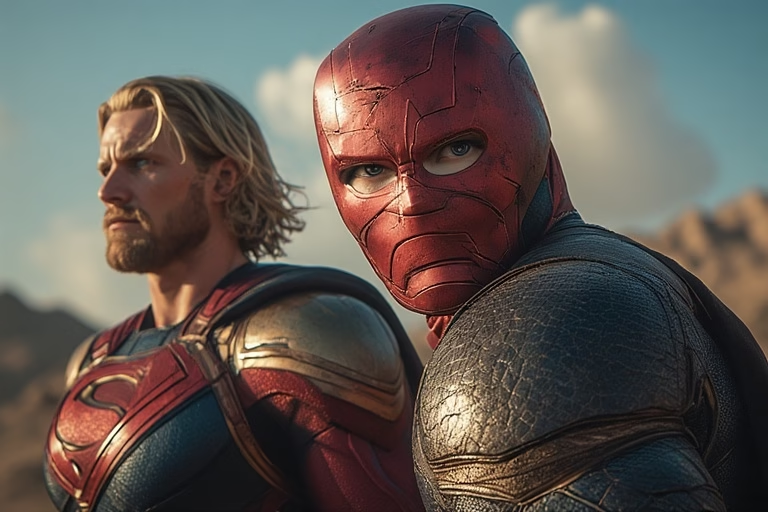
The universe has been shattered. The multiverse hangs by a thread. All the battles, the sacrifices, the endless struggle to maintain balance—they have all been leading to this single moment. The moment of Avengers Doomsday.
Scheduled for 2027, this isn’t just another Marvel film. It’s the culmination of everything that began with Avengers: The Kang Dynasty. It’s the final chapter of the Multiverse Saga. And it may very well be the last time we see this version of Earth’s Mightiest Heroes assembled.
In this definitive guide, we’ll explore what makes Avengers: Doomsday different from any Marvel film that came before it. We’ll break down the cosmic stakes, analyze the new team dynamics, and reveal how this film will not just conclude a story—but transform the entire Marvel Cinematic Universe forever.
The Point of No Return: Understanding the Doomsday Scenario
What “Doomsday” Really Means
In the context of the MCU, “Doomsday” isn’t just a dramatic title. It’s a literal description of the event that will shake the multiverse to its core. Following the events of The Kang Dynasty, the fabric of reality has been stretched beyond its breaking point. The rules no longer apply. Physics is breaking down. And the Avengers are facing something they cannot punch, negotiate with, or reason with.
The Three Pillars of the Coming Storm
- The Incursion Cascade – Reality itself is unraveling
- The Legacy of Kang – A power vacuum that threatens all existence
- The Rise of New Powers – Forces beyond comprehension are awakening
The Last Avengers: A Team Unlike Any Other
The Unlikely Leaders
The old guard is gone. The new leadership reflects the complex, multiversal nature of the threat they face.
Doctor Strange – The Guardian of Reality
Having witnessed the destruction of countless universes, Strange now understands that some sacrifices must be made for the greater good. His journey from arrogant surgeon to burdened cosmic guardian reaches its climax here.
Sam Wilson’s Captain America – The Moral Compass
In a world where reality itself is flexible, Sam represents the unchanging values that make humanity worth saving. He’s not the strongest Avenger, but he might be the most important.
Shuri’s Black Panther – The Architect of Tomorrow
With Wakanda’s resources and her own genius intellect, Shuri represents the only chance at building a future from the ashes of the present.
The Power Core
Captain Marvel – The Cosmic Heavyweight
Her power levels will be tested like never before as she confronts threats that dwarf planetary-scale dangers.
Shang-Chi – The Master of Cosmic Energy
The Ten Rings are revealed to be far more than weapons—they’re keys to understanding the fundamental forces of the multiverse.
Thor – The God of Broken Realms
The once-mighty Thor now faces challenges that even his godly power may not be enough to overcome.
The Wild Cards
Spider-Man – The Human Element
Peter Parker’s scientific genius and street-level perspective make him crucial for keeping the team grounded in reality—even as reality itself falls apart.
The Fantastic Four – The Scientific Vanguard
Reed Richards’ intellect may be the only thing capable of understanding the physics of the collapsing multiverse.
The Threat Beyond All Threats
Not a Villain—A Process
Avengers: Doomsday introduces a revolutionary concept for a superhero film: the main antagonist isn’t a person, but a process. The Doomsday event is the multiverse equivalent of a system failure. It cannot be reasoned with. It cannot be defeated. It can only be survived—or reset.
The Battle for Reality Itself
The conflict in Doomsday operates on three simultaneous levels:
- The Physical Battle – Fighting to maintain stability in a universe where matter itself is unreliable
- The Temporal War – Struggling to preserve causality in a reality where time is no longer linear
- The Conceptual Conflict – Defending the very idea of existence against forces that seek to unmake it
The Narrative Structure: A Three-Act Apocalypse
Act I: The Unraveling
The film opens in the immediate aftermath of The Kang Dynasty. Reality is fraying at the edges. People blink in and out of existence. Locations shift and change. The Avengers are scattered, trying to contain localized reality collapses while realizing they’re fighting symptoms, not the disease.
Act II: The Great Choice
The team discovers the horrifying truth: to save the multiverse, they must make an impossible choice. They can either:
- Let the Doomsday event run its course and hope something new emerges from the chaos
- Trigger a controlled collapse and attempt to rebuild reality from scratch
- Make a desperate gamble that could save everything—or destroy what little remains
Act III: The Last Stand
The final act takes place across multiple collapsing realities as the Avengers make their choice and live with the consequences. The climax isn’t a traditional battle, but a reality-altering event that will redefine the Marvel Universe for the next generation.
The Aftermath: Life After Doomsday
The Soft Reboot
Avengers: Doomsday will serve as the perfect opportunity for Marvel to:
- Naturally introduce the X-Men and mutants into the MCU
- Reset character relationships and status quos
- Create a new, streamlined timeline free from continuity constraints
- Launch the next generation of Marvel stories
The New Marvel Universe
The film will likely end with a transformed—but familiar—Marvel Universe. Key elements will remain, but the playing field will be reset, allowing for new stories while honoring what came before.
Why Doomsday Matters
More Than Just Entertainment
Avengers: Doomsday represents a bold new direction for superhero storytelling. It’s a film that asks profound questions:
- What is reality worth?
- What sacrifices are too great?
- How do we find hope when facing the end of everything?
The Emotional Core
Despite the cosmic scale, the heart of the film remains the characters we’ve grown to love over decades of storytelling. Their final stand isn’t just about saving the universe—it’s about proving that their journey, their sacrifices, and their friendships meant something.
Preparing for the End
Essential Viewing
To fully appreciate Avengers: Doomsday, audiences should be familiar with:
- Loki (both seasons)
- Doctor Strange in the Multiverse of Madness
- Ant-Man and The Wasp: Quantumania
- Avengers: The Kang Dynasty
- The Fantastic Four
What to Expect
- The most ambitious visual effects in Marvel history
- Emotional conclusions to long-running character arcs
- Game-changing revelations about the nature of the MCU
- A satisfying conclusion that honors the past while embracing the future
Conclusion: The End is Just the Beginning
Avengers: Doomsday represents both an ending and a beginning. It’s the final chapter of the Multiverse Saga and the opening volley of whatever comes next for Marvel. More importantly, it’s a testament to the enduring power of heroism—even when facing the end of everything.
As we count down to 2027, one thing is certain: when Doomsday arrives, nothing will ever be the same again. And that might be exactly what the Marvel Universe needs.
What do you think will be the fate of our favorite heroes? Which character are you most worried about facing Doomsday? Share your predictions in the comments below!