
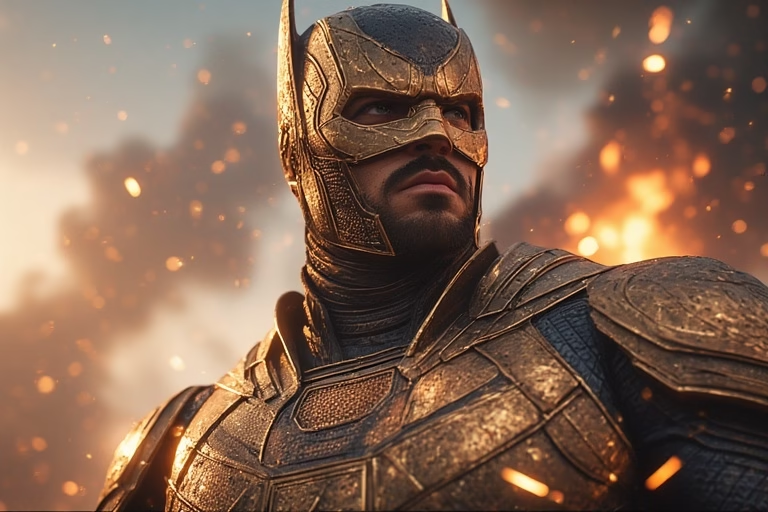
The universe has been snapped away and restored. The sacred timeline has been shattered into infinite possibilities. But Earth’s Mightiest Heroes are about to face a threat that makes these previous crises seem like minor disturbances. The coming cataclysm has a name, and it is Avengers Doomsday—the 2027 cinematic event that will challenge not just the Avengers’ power, but their very reason for existing in a multiverse teetering on the brink of collapse.
This isn’t merely the next installment in the Marvel Cinematic Universe. This is the grand finale of the Multiverse Saga—the moment where every narrative thread from Phase Four through Six converges in either glorious salvation or absolute oblivion. While Avengers: Endgame concluded a decade-long story, Avengers Doomsday will define the next decade of Marvel storytelling, potentially rebooting the entire cinematic universe as we know it.
In this definitive guide, we will analyze everything from the fundamental plot mechanics to the profound character arcs that will drive this monumental film. We’ll explore not just what might happen, but the deeper thematic significance behind the coming catastrophe and its lasting impact on the Marvel landscape.
The Foundation: Understanding the Path to Destruction
To comprehend the magnitude of Avengers Doomsday, we must first survey the fractured landscape of the current MCU. The universe is no longer a single, stable timeline but a fragile ecosystem of realities with its fundamental laws breaking down.
The Incursion Crisis
The central concept driving toward Avengers Doomsday is the Incursion phenomenon. First properly explained in Doctor Strange in the Multiverse of Madness, an Incursion occurs when the boundary between two universes collapses, causing them to collide and be utterly annihilated. The terrifying prospect for Avengers Doomsday is not a single Incursion, but a cascade effect—a chain reaction of collapsing realities that could erase the entire multiverse from existence. This represents a fundamental shift from fighting villains to confronting cosmic entropy itself.
The Kang Conundrum and Its Consequences
The death of He Who Remains in Loki created a power vacuum that has led to an explosion of branching realities and a war between Kang variants. This conflict isn’t just creating chaos—it’s systematically damaging the architecture of reality. Each battle between Kang variants creates temporal ripples that weaken dimensional boundaries, making the multiverse increasingly unstable. The Kang war serves as the catalyst that pushes an already fragile multiverse past its breaking point.
The New Avengers: A Coalition of Necessity
The roster facing this existential threat will be the most diverse and complex assembly of heroes yet seen—a coalition drawn from every corner of the MCU with complementary skills and conflicting perspectives.
The Strategic Command
This trio will form the operational brain of the team, each bringing essential but contrasting leadership qualities:
- Doctor Strange serves as the Multiversal Architect. Having witnessed the destruction of other worlds and caused an Incursion himself, he possesses both the knowledge and the guilt that drives him toward redemption. His character arc will likely involve overcoming his tendency toward arrogant solo solutions and learning to trust a team with reality itself at stake.
- Sam Wilson’s Captain America embodies the Moral Foundation. In a crisis that could make conventional morality seem irrelevant, Sam’s unwavering commitment to preserving life—every life—provides the ethical compass the team desperately needs. His journey from counseling veterans to leading Earth’s defense against cosmic annihilation represents one of the MCU’s most compelling transformations.
- Shuri’s Black Panther provides the Technological Bridge. As a scientist who has transcended grief and embraced her royal destiny, she can build the tools to interface with dying realities while understanding the philosophical weight of their decisions. Her perspective as both monarch and innovator makes her uniquely qualified to balance practical solutions with ethical considerations.
The Power Core
These heroes bring the raw power and specialized abilities needed to operate across collapsing realities:
- Captain Marvel functions as the Universal Guardian. Her ability to operate across galactic distances and interface with cosmic energy makes her the first line of defense against multiversal decay. Her character development may involve reconciling her cosmic responsibilities with her earthly connections.
- Shang-Chi emerges as the Mystical Keystone. The Ten Rings are revealed to be not just weapons but cosmic anchors—artifacts designed to maintain dimensional stability. His mastery of them becomes crucial to understanding and potentially halting the collapse.
- Thor represents Cosmic Endurance. As a being whose life force is intrinsically tied to the cosmic order, he provides both the power and perspective of someone who has witnessed universes born and died. His newfound role as a father gives him personal stakes in preserving reality itself.
The Specialist Division
These heroes provide unique capabilities that prove essential in navigating the crisis:
- Scott Lang and Hope van Dyne serve as Quantum Specialists. Their experience in the Quantum Realm—a dimension that appears to exist outside standard multiversal physics—could provide crucial insights or safe havens as reality disintegrates.
- Spider-Man evolves into the Human Anchor. His scientific genius, combined with his firsthand multiversal experience and street-level humanity, makes him the bridge between cosmic scale and human consequence.
- Hulk embodies the Gamma Paradox. Bruce Banner’s mind can analyze the energy patterns of collapsing universes, while Hulk’s unique gamma signature may hold unexpected properties in the face of reality-altering events.
The Nature of the Threat: Understanding “Doomsday”
The title suggests a threat beyond any single villain—a process or entity that represents existential finality.
Primary Theory: The Entropy Cascade
The most scientifically plausible scenario involves the Kang war triggering an irreversible entropy cascade across the multiverse. As reality structures decay, the laws of physics become increasingly unreliable, leading to spontaneous existence failure across multiple dimensions. The “Doomsday” isn’t an enemy but a state of cosmic dissolution—the multiverse equivalent of heat death.
Secondary Theory: The Living Tribunal’s Judgment
In this scenario, the chaotic proliferation of timelines and reality violations draws the attention of cosmic entities like the Living Tribunal, who determine that the current multiverse experiment has failed and must be terminated for the greater cosmic good. The Avengers must then argue for existence itself before ultimate cosmic judges.
Tertiary Theory: The Emergence of Abraxas
The destruction of multiple realities could unleash Abraxas—the embodiment of destruction and anti-creation—from his cosmic prison. As the counter-force to Eternity, his emergence would represent the systematic unmaking of all existence, making him the literal embodiment of doomsday.
The Narrative Structure: A Five-Act Apocalypse
Act I: The Cracks Appear
The film opens with the Avengers dealing with the aftermath of The Kang Dynasty. Strange reality anomalies begin occurring globally—people flickering between versions, locations existing in multiple places simultaneously, and fundamental physical laws becoming unreliable. The team initially treats these as isolated incidents until a major European city vanishes in an Incursion event, making the scale of the threat undeniable.
Act II: The Science of Collapse
The Avengers establish a crisis headquarters where Banner, Shuri, and Pym work to understand the physics of the collapse while Strange and Wong investigate the mystical aspects. They discover the cascade is accelerating exponentially and identify patterns suggesting intentional manipulation of the decay process.
Act III: The Battle for Reality
The team identifies a potential solution—using the Quantum Realm as a stable reference point to “reboot” the multiverse—but accessing it requires coordinating with variants and former enemies across dying realities. This act features unprecedented team-ups and moral compromises as different factions propose conflicting solutions to the crisis.
Act IV: The Sacrifice
The implementation of their solution requires impossible choices and profound sacrifices—potentially including the permanent loss of major characters who must become anchors for the new reality structure. This act culminates in a reality-altering event that resets the multiverse.
Act V: The New Dawn
The film concludes with a transformed Marvel universe—one that naturally incorporates previously separate elements like mutants and the Fantastic Four while maintaining core MCU continuity. The ending is bittersweet, celebrating survival while mourning what was lost in the rebirth.
The Lasting Impact: Marvel’s New Universe
The aftermath of Avengers Doomsday will fundamentally reshape the MCU:
- Mutant Integration: The reality reset provides an elegant mechanism for introducing mutants as always having existed but previously hidden or dormant.
- Fantastic Foundation: Reed Richards and his family emerge as architects of the new reality, positioned as central figures in the post-doomsday universe.
- Streamlined Continuity: The complex multiversal rules are resolved into a cohesive timeline that honors legacy while enabling new storytelling possibilities.
- Legacy Evolution: The next generation of heroes fully assumes the Avengers mantle while classic characters transition to new roles.
The Philosophical Dimensions
Beyond spectacle, Avengers Doomsday explores profound questions:
- What responsibility do heroes bear when their victories cause larger problems?
- How do we define victory when perfect solutions are impossible?
- What makes existence worth preserving in the face of inevitable decay?
- Can hope remain meaningful when facing absolute finality?
These themes elevate the film from entertainment to meaningful commentary on resilience, purpose, and the human spirit facing cosmic indifference.
Conclusion: The Meaning in the Ruins
Avengers Doomsday represents the ultimate test of the Avengers concept—not just whether they can win, but whether their heroism has meaning when facing forces beyond comprehension. The film will challenge our heroes to evolve from defenders of a world to architects of reality itself.
The coming storm cannot be avoided, but through the courage and sacrifice of Earth’s Mightiest Heroes, destruction may yet be transformed into renewal. The universe that emerges from doomsday will be different—scarred but resilient, complex but cohesive, and ready for new stories yet untold.
When reality itself crumbles, the Avengers will face their final test: not just to save what exists, but to imagine what could be—and make that vision real.
Which character do you think will play the most crucial role in Avengers: Doomsday? What legacy characters would you like to see return for this final battle? Share your thoughts and theories in the comments below!
