
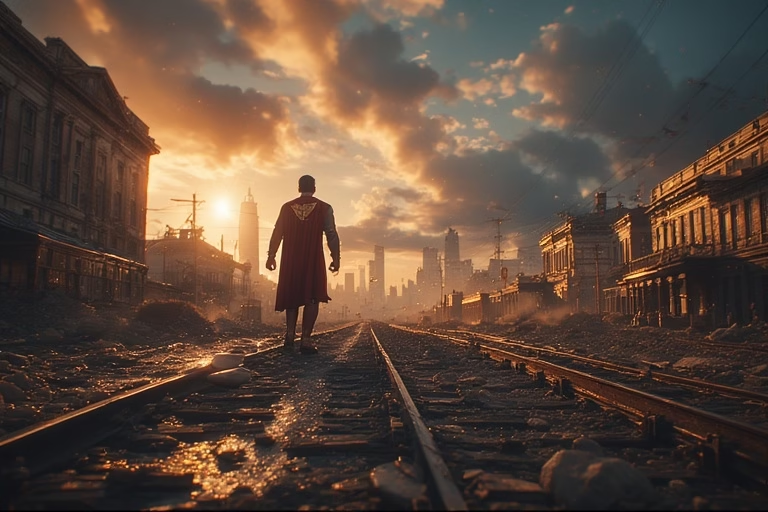
The universe has been snapped away and restored. The very fabric of reality has been torn apart by multiversal war. But Earth’s Mightiest Heroes are about to face a threat that makes these previous conflicts seem trivial. The coming catastrophe has a name, and it is Avengers Doomsday—the 2027 cinematic event that will challenge not just the Avengers’ strength, but their very reason for existing.
This isn’t merely the next chapter in the Marvel Cinematic Universe. This is the grand finale of the Multiverse Saga—the moment where every narrative thread from Phase Four through Six converges in either glorious salvation or absolute oblivion. While Avengers: Endgame concluded a decade-long story, Avengers Doomsday will define the next decade of Marvel storytelling, potentially rebooting the entire universe as we know it.
In this comprehensive guide, we will analyze everything from the fundamental plot mechanics to the profound character arcs that will drive this monumental film. We’ll explore not just what might happen, but the deeper thematic significance behind the coming catastrophe. Prepare for a deep dive into what could be Marvel’s most ambitious and transformative project to date.
The Foundation: Understanding the Road to Doomsday
To comprehend the magnitude of Avengers Doomsday, we must first survey the fractured landscape of the current MCU. The universe is no longer a single, stable timeline but a fragile ecosystem of realities with its immune system failing.
The Incursion Problem
The single most important concept driving toward Avengers Doomsday is the Incursion. First properly explained in Doctor Strange in the Multiverse of Madness, an Incursion occurs when the boundary between two universes collapses, causing them to collide and be utterly destroyed. The terrifying prospect for Avengers Doomsday is not a single Incursion, but a cascade—a chain reaction of collapsing realities that could wipe out the entire multiverse. This isn’t a villain to defeat but a cosmic cancer to cure, making it fundamentally different from any threat the Avengers have faced before.
The Power Vacuum and Its Consequences
With the death of He Who Remains in Loki, the Sacred Timeline is no longer being pruned. This has led to an explosion of branching realities and, consequently, a war between Kang variants vying for control. This conflict itself acts as the catalyst that weakens the fabric of reality to the breaking point. Think of it as too many programs running simultaneously on a computer—eventually, the entire system crashes. The Kang war isn’t just creating chaos; it’s overloading the fundamental architecture of existence, directly leading to the “Doomsday” event.
The New Avengers: A Team Forged in Crisis
The roster facing this existential threat will be unlike any we’ve seen—a coalition of necessity that pulls together heroes from every corner of the MCU with complementary skills and perspectives.
The Strategic Command Trio
This trio will form the brain and heart of the operation, each bringing essential but different leadership qualities:
- Doctor Strange serves as the Multiversal Expert and Reluctant Prophet. Having witnessed the destruction of other worlds and caused an Incursion himself, he possesses the knowledge and guilt that makes him essential. He understands the science and magic of the coming collapse but struggles with the moral weight of decisions that could sacrifice entire realities.
- Sam Wilson’s Captain America is the Moral Compass and Practical Leader. In a crisis that could make hope feel naive, Sam’s unwavering belief in people and his ground-level tactical experience will be crucial. He represents not just why they must fight, but how to maintain humanity while doing so. His journey from pararescue to leading Earth’s mightiest heroes against cosmic annihilation completes one of the MCU’s most compelling character arcs.
- Shuri’s Black Panther provides the Technological and Philosophical Bridge. As a scientist who has dealt with loss and transformation, she can build the tools to interact with a dying multiverse while understanding the philosophical implications. Her perspective as a monarch and innovator makes her uniquely qualified to balance practical solutions with ethical considerations.
The Power Division
These heroes bring the raw power and specialized abilities needed to face cosmic-level threats:
- Captain Marvel is the Strategic Heavy Artillery. When the conflict spans galaxies and dimensions, her ability to operate in any environment and project power across solar systems becomes non-negotiable. Her character arc may involve learning that some problems can’t be solved through sheer force alone.
- Shang-Chi is the Mystical Wild Card. The Ten Rings are not just weapons but a cosmic beacon of unknown origin. Their power and purpose are intrinsically linked to forces beyond Earth, potentially making him a conduit or key to understanding the nature of the multiversal collapse.
- Thor is the Cosmic Constant and Living History. As a god, his life force is tied to the cosmic order. Having witnessed the birth and death of galaxies, he provides perspective when others see only immediate crisis. His newfound role as a father may give him a personal stake in preserving reality itself.
The Specialist Corps
These heroes provide unique, irreplaceable skills that will prove crucial in unconventional circumstances:
- Ant-Man & The Wasp are the Quantum Realm Specialists. Their experience in the Quantum Realm—a dimension that may exist outside standard multiversal physics—could provide safe haven or unique solutions. Scott Lang’s everyman perspective will be crucial for grounding the team when discussions become too abstract.
- Spider-Man is the Heart and Scientific Mind. His brilliant scientific intellect, combined with his firsthand multiversal experience and unparalleled resilience, makes him the bridge between street-level heroism and cosmic crisis. His journey from friendly neighborhood hero to essential multiversal defender completes a remarkable character transformation.
- Hulk is the Gamma Genius and Emotional Anchor. Bruce Banner’s mind is needed to understand the energy signatures of a dying universe, while his hard-won emotional balance helps stabilize the team during moments of despair.
The Antagonist: What is “Doomsday”?
The title suggests a threat beyond a single villain. The antagonist of this film is likely a concept or a process that has been unleashed, making it fundamentally different from Thanos or previous villains.
Primary Theory: The Incursion Cascade
This is the most scientifically grounded and likely scenario. The war among Kang variants destabilizes the multiverse, triggering a geometric progression of Incursions. The “Doomsday” is not a villain to be punched but a process to be stopped—a wave of annihilation sweeping across all realities. The Avengers’ goal becomes one of cosmic triage: how do you perform emergency surgery on reality itself? This premise allows for profound philosophical questions about sacrifice, the greater good, and what truly matters when everything is ending.
Secondary Theory: The Beyonder and Battleworld
In this scenario, inspired by the comics’ Secret Wars, the multiverse’s collapse is observed by a nigh-omnipotent being—the Beyonder. He doesn’t stop the destruction; he curates it, gathering the last fragments of dying worlds to create a patchwork planet called Battleworld. The Avengers would then be forced to survive and scheme under the rule of a capricious god, fighting not for victory, but for the right to restore existence. This scenario provides incredible narrative flexibility, allowing for cameos and team-ups previously thought impossible.
Tertiary Theory: The Emergence of a True Final Boss
It’s possible that the chaos of the multiversal collapse awakens or creates an entity of pure destruction. This could be a corrupted Celestial, the embodiment of the Void from Loki (Alioth), or even a completely new character like the Beyonders from the comics—beings who view the multiverse as a temporary experiment. This approach would maintain the traditional villain structure while elevating the stakes to unprecedented levels.
The Narrative Arc: A Three-Act Structure for the Apocalypse
Based on the established lore and narrative patterns, here is a plausible structure for Avengers Doomsday.
Act I: The Unraveling (The Science of Collapse)
The film opens with the Avengers at their lowest point following the events of The Kang Dynasty. They are scattered, defeated, and grieving significant losses. The first act shows the initial signs of multiversal decay—strange gravitational anomalies, people remembering events that never happened, and brief visions of other worlds. The first major Incursion occurs midway through the act, visible from Earth as a celestial catastrophe of unimaginable scale. Realities begin to bleed into each other; laws of physics break down in localized areas. The heroes must regroup not to fight an enemy, but to confront an ontological crisis. The act ends with the confirmation that this is a cascade—it is unstoppable, accelerating, and will consume everything.
Act II: The Refuge and The Rule (The Politics of Survival)
As reality disintegrates, a mysterious force intervenes. The heroes awaken on Battleworld, a terrifying mosaic of landscapes and characters from across the MCU and other Marvel properties. Here, they encounter the ruler of this domain and must learn to navigate a society where fragments of different realities coexist under strict control. This act focuses on unlikely alliances, political maneuvering, and the moral compromises necessary for survival. The central conflict shifts from warfare to strategy and diplomacy as the Avengers must convince other survivors to join their cause while uncovering the secret to undoing the collapse.
Act III: The Sacrifice and The Rebirth (The Philosophy of Creation)
The heroes discover that restoring the multiverse requires a monumental sacrifice that challenges their fundamental values. The climax involves a reality-altering event where characters must make impossible choices about what to preserve and what to let go. The resolution sees a new, unified timeline forming—one that naturally incorporates mutants, the Fantastic Four, and establishes a new status quo for the MCU. The film ends not with a victory celebration, but with a quiet moment of reflection on what was lost and what was saved, setting the stage for the next era of Marvel storytelling.
The Aftermath: A New Marvel Universe
The impact of Avengers Doomsday will be more profound than any previous Marvel film, potentially rebooting the entire universe while honoring its history.
- The Mutant Introduction: The reality-reboot provides a clean, elegant mechanism for introducing mutants. The “X-gene” can be revealed as always having been present but dormant, or activated by the cosmic energy of the rebirth. This avoids complicated retcons while establishing mutants as fundamental to the new timeline.
- The Fantastic Four’s Arrival: Reed Richards could be instrumental in solving the “Doomsday” equation, seamlessly introducing his family as essential figures in the new reality. Their scientific genius and experience with cosmic forces make them natural pillars of the rebuilt universe.
- A Streamlined Timeline: The complex, often confusing multiversal rules are resolved into a single, stable timeline. This gives Marvel creative freedom for future stories while maintaining continuity for beloved characters and relationships.
- The True Passing of the Torch: The film will solidify the next generation of heroes as the definitive Avengers moving forward, while allowing legacy characters to conclude their arcs with dignity and purpose.
The Deeper Meaning: What Doomsday Represents
Beyond the spectacle, Avengers Doomsday represents a crucial thematic evolution for the MCU. The film will likely explore:
- The Limits of Power: When raw strength cannot solve the problem
- The Nature of Reality: What remains when everything familiar disappears
- The Essence of Heroism: What it means to be heroic when traditional heroism fails
- The Price of Creation: What must be sacrificed to build something new
These themes elevate the film from simple entertainment to meaningful commentary on resilience, adaptation, and hope in the face of absolute uncertainty.
Conclusion: The Final Test of the Avengers Idea
Avengers Doomsday will ultimately test the very concept of heroism in the Marvel Universe. What does it mean to be a hero when you cannot punch your problem? What is the value of courage when facing the literal end of everything? How do you maintain hope when all evidence suggests hope is futile?
The film promises to be a spectacular, universe-altering event, but its heart will be the same as it was in 2012: a group of people, with all their flaws and differences, choosing to stand together against the darkness. They will face the end of everything not as gods or soldiers, but as heroes. And in doing so, they will not just save a universe—they will build a new one, setting the stage for countless stories to come.
The coming storm cannot be prevented. But through the courage of Earth’s Mightiest Heroes, it may yet be transformed into a new beginning.
Which theory do you find most compelling for the “Doomsday” event? How do you think the MCU will change after this film? Join the conversation in the comments below and share your predictions!
