
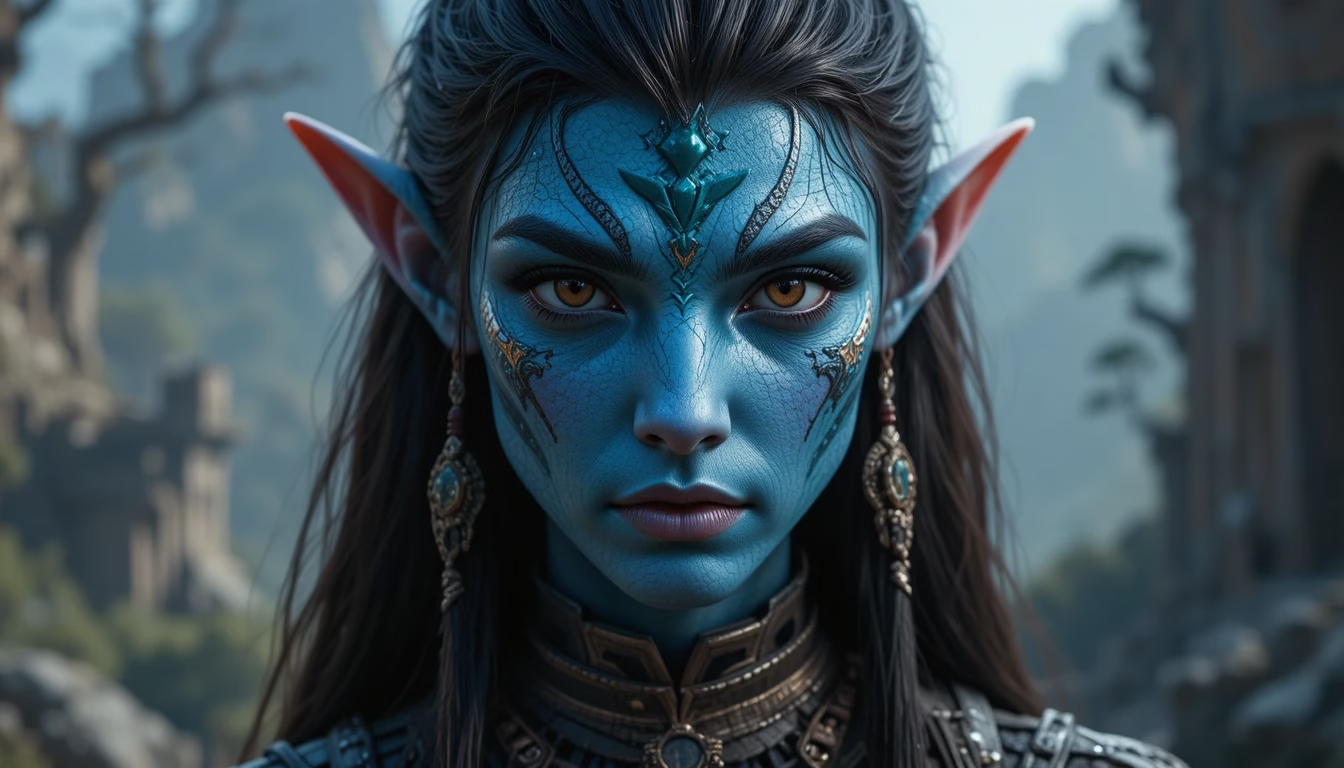
It was 2009. The world was still reeling from a financial crisis, smartphones were becoming our new appendages, and a little film with blue aliens was about to change cinema forever. Avatar wasn’t just released; it was an event. It became a cultural touchstone, a box office leviathan that sailed past every record, and for a few glorious hours in a dark theater, it made millions of us believe in a world called Pandora.
But then, a curious thing happened. In the years that followed, a narrative emerged: “Avatar made all the money, but left no cultural footprint.” Critics claimed no one could name a character, that the quotes weren’t memorized, that the toys weren’t sold. They were wrong. They were looking for impact in the wrong places. The legacy of Avatar isn’t found on a t-shirt; it’s etched into the DNA of modern filmmaking and the human yearning for connection.
This is a defense and a deep appreciation of the original film. This is an exploration of why Avatar‘s magic isn’t just special effects, but something far more profound.
The Myth of “No Cultural Impact”: A Flawed Argument
The “no cultural impact” argument is fundamentally flawed because it measures impact by the standards of a pre-internet, franchise-obsessed world. It expects memes and water-cooler quotes. Avatar’s impact was different, but no less real.
- The “Avatar” Effect on Technology: The film didn’t just use existing technology; it forced it to evolve. The development of new cameras, performance capture in realistic environments, and advances in CGI were all accelerated by Cameron’s uncompromising vision. Every film that uses seamless CGI today owes a debt to Avatar.
- The Theme Park Phenomenon: While other franchises sell action figures, Avatar sells an experience. Pandora – The World of Avatar at Disney’s Animal Kingdom is not just a ride; it’s a pilgrimage. Visitors wait for hours to fly on a banshee, touch bioluminescent plants, and drink in the awe-inspiring landscape. This is cultural impact you can walk through, a testament to the world’s lasting power.
- The Environmental Awakening: Avatar arrived as climate consciousness was entering the mainstream. It wasn’t a subtle allegory; it was a screaming, vibrant, and emotionally charged plea for environmentalism. It made audiences feel the loss of a tree, not just understand it. For a generation of young people, it was their first, visceral introduction to the concepts of ecosystem interconnectedness and corporate exploitation.
Deconstructing the “Dances with Wolves in Space” Critique
Yes, the plot follows the archetypal “Hero’s Journey” and shares DNA with stories like Dances with Wolves and Pocahontas. But to dismiss it for this is to miss the point entirely. Mythology endures precisely because it retells fundamental human stories.
Cameron didn’t invent a new story; he invented a new way to tell a story. The power of Avatar isn’t in its plot originality, but in its experiential originality. He used a familiar narrative framework as a sturdy vessel to carry audiences into a world so immersive, they forgot they were watching a screen. The story isn’t the what; it’s the how.
The Secret Sauce: The Unforgettable World-Building of Pandora
This is where the true, lasting magic lies. Cameron and his team didn’t just create a movie set; they built a believable, scientific, and spiritual ecosystem.
The Science of Belief:
Pandora feels real because it was designed with scientific principles in mind.
- The Flux Vortex: The floating mountains are explained by the “flux vortex” and the room-temperature superconductor, Unobtanium. This gives the fantasy a grounding in plausible (if futuristic) physics.
- The Neural Network: Eywa isn’t just a “goddess”; it’s a planetary neural network, a biological internet connecting all life. This blends spirituality with a concept of cosmic connectivity that feels both ancient and futuristic.
- The Creature Design: Every creature, from the six-legged Direhorse to the hammer-headed Titanothere, follows evolutionary logic. They feel like they belong in their environment.
The Spiritual Core:
The phrase “I see you” became the film’s true, lasting quote. It didn’t mean “I see you with my eyes.” It meant, “I see your soul. I understand your essence. I acknowledge your existence.” In an increasingly disconnected world, this simple phrase resonated on a deep, human level. It was a call for empathy in its purest form.
The Cameron Prophecy: A Vision That Predated Our World
Look at the world of Avatar and then look at our world today.
- The “Dreamwalking” Avatars: In 2009, the idea of projecting our consciousness into a remote, artificial body was pure science fiction. Today, with the rapid development of VR, AR, and the metaverse, it feels like a logical, impending reality. Cameron didn’t just predict a technology; he predicted a human desire.
- The Destructive “Sky People”: The portrayal of the Resources Development Administration (RDA) as a faceless, profit-driven corporation strip-mining a world for a precious resource feels less like a 2009 allegory and more like a documentary of 2024.
- The Yearning for Connection: In an age of digital isolation and environmental anxiety, the core message of Avatar—that true living comes from connection to each other and the natural world—is more relevant than ever.
Conclusion: The Legacy is the Feeling
The true legacy of Avatar isn’t a quote, a meme, or a character name. It’s a feeling.
It’s the feeling of wonder you had when you first saw the floating Hallelujah Mountains. It’s the thrill you felt when Jake Sully tamed his first banshee. It’s the ache in your heart as the Home Tree fell. It’s the memory of walking out of the theater and, for a moment, seeing our own world—its trees, its animals, its interconnectedness—with new, more appreciative eyes.
Avatar reminded us of the power of pure, cinematic spectacle to make us feel small and significant all at once. It proved that a film could be a technological revolution and a spiritual journey. Pandora isn’t just a place in a movie; it’s an idea. It’s the dream of a world in balance, and the warning of what happens when we lose it. And that is a cultural impact that will endure for generations.
What was your most powerful memory of first seeing Avatar? Did it change how you saw our world? Share your experience in the comments below.
