
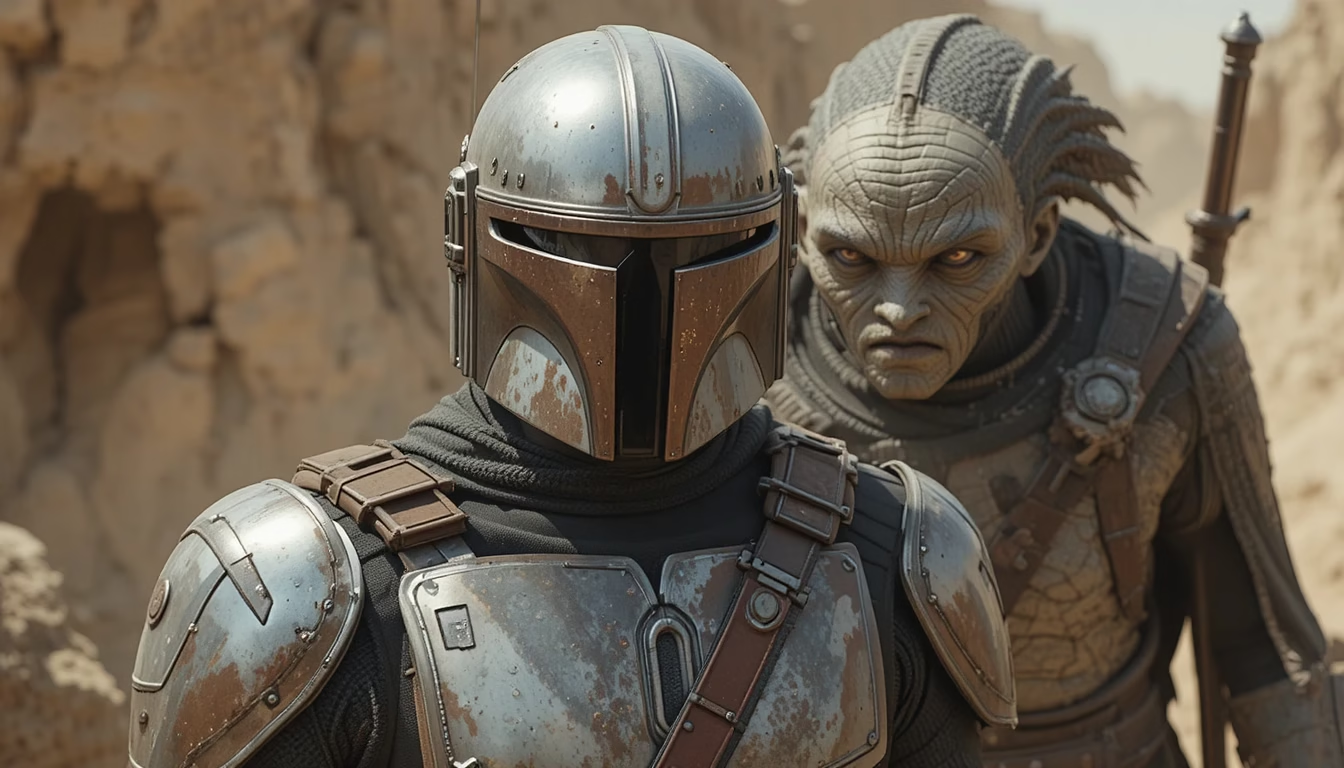
The announcement was simple; the implications are galactic. The Mandalorian & Grogu, the upcoming feature film from Jon Favreau, is not merely the next adventure for our favorite armored duo. It is the fulcrum upon which the future of the Star Wars universe will tilt. This is not just a story about a father and son; it is a story about a galaxy in flux, a fragile peace, and the violent birth pangs of a new era.
For three seasons, we witnessed a microcosm of this struggle through the lens of Din Djarin. His journey from isolated bounty hunter to clan leader mirrored the galaxy’s own painful transition from the tyranny of the Empire to the uncertain promise of the New Republic. But as Season 3 concluded, it became clear that the real story is only just beginning. The reclamation of Mandalore was not an ending; it was a opening move in a much larger, more dangerous game.
This analysis goes beyond simple speculation. We will dissect the political landscape, the emerging threats, and the narrative machinery that makes this film the most significant Star Wars project since the sequel trilogy. We are here to understand not just what will happen, but why it matters on a galactic scale.
Section 1: The Pre-Film Galaxy – A Landscape of Fragile Alliances and Power Vacuums
To understand where the film must go, we must first accurately diagnose the state of the galaxy.
The New Republic: A Sleeping Giant
The New Republic, in the era of The Mandalorian, is complacent. We’ve seen this through the eyes of Carson Teva—a dedicated pilot hamstrung by bureaucracy. They have disarmed, demilitarized, and are willfully ignoring the warning signs in the Outer Rim. This central weakness is the single most important factor in the rise of new threats. The galaxy has a power vacuum, and nature abhors a vacuum.
The Mandalorian People: A Fractured Rebirth
While Bo-Katan Kryze holds the title of ruler and Mandalore is technically reclaimed, the Mandalorian culture remains deeply fractured. The ideological schism between the Children of the Watch and more secular clans like Bo-Katan’s is not easily healed. They are a formidable but unstable force, a sleeping dragon that, if united under a common cause, could tip the scales of any galactic conflict.
The Imperial Remnant: A Hydra Awakening
This is not the Empire of Palpatine. This is something new and perhaps more insidious. The remnants have been scattered, operating as criminal syndicates and isolated warlords. But the return of a strategic mastermind like Grand Admiral Thrawn changes everything. He represents the potential to transform these scattered, angry cells into a disciplined, coordinated, and terrifyingly efficient war machine.
Section 2: The Central Conflict – Why Din Djarin is the Unwilling Key
In this volatile landscape, Din Djarin is the ultimate wild card. He is not a general, a politician, or a Jedi. He is a man of simple codes and direct action, which makes him uniquely dangerous to the plans of schemers and strategists.
The Father as a Political Actor
Din Djarin’s entire motivation is now hyper-personal: the safety and upbringing of Grogu. However, in a galaxy seeking to exploit any advantage, this personal mission has profound political consequences. His actions to protect his son will inadvertently:
- Antagonize the New Republic: If he takes matters into his own hands, violating their jurisdiction.
- Unite the Mandalorians: His status as a hero and a true believer makes him a potent symbol who can bridge ideological divides.
- Attract the Empire’s Ire: Grogu remains one of the most valuable assets in the galaxy.
The Grogu Factor: A Nexus of Power
Grogu is more than a child; he is a nexus point where several powerful forces converge.
- The Force: His connection makes him a target for dark side practitioners and a beacon for light side users.
- Imperial Science: The remnants of Project Necromancer and Dr. Pershing’s work prove the Empire’s relentless desire to understand and harness the Force, with Grogu as the ultimate specimen.
- Mandalorian Lore: As a Mandalorian Foundling, he represents the future of its culture—a Force-wielding Mandalorian, a concept with no precedent.
Section 3: The Antagonists – A Tiered Analysis of Cinematic Threats
A film requires a villain of commensurate scale. Let’s analyze the candidates not just by who they are, but by the narrative function they serve.
Tier 1: The Strategic Threat – Grand Admiral Thrawn
- Narrative Function: To provide a cerebral, galactic-scale threat. A conflict with Thrawn is not won with a blaster, but with wit and strategy. He is the anti-Vader.
- Why He Fits: Thrawn’s return in Ahsoka makes him the most logical and compelling antagonist. He would not see Din Djarin as a primary target, but as an unpredictable variable. His goal would be to neutralize or acquire Grogu as a strategic asset to understand the “magic” of the Force that has always confounded his logical mind.
- The Cinematic Potential: Thrawn offers a cool, calculating, and chilling presence. A scene of him analyzing Din Djarin’s tactics and deducing his motivations would be as tense as any lightsaber duel.
Tier 2: The Existential Threat – The Grysk
- Narrative Function: To introduce a completely new, external threat that forces old enemies to unite. They are the “unknown” that makes the Imperial Civil War look petty.
- Why They Fit: The Grysk are established in canon novels as Thrawn’s true fear. Introducing them in this film would instantly raise the stakes to a galactic survival level, justifying the team-up of Mandalorians, the New Republic, and even Thrawn’s forces.
- The Cinematic Potential: A truly alien and ruthless enemy would allow for horrifying creature design and battle sequences unlike anything seen before in Star Wars cinema.
Tier 3: The Personal Threat – A Resurrected Moff Gideon
- Narrative Function: To provide a personal, vengeful finale to the duo’s original saga.
- Why He Fits: Giancarlo Esposito’s performance is iconic. The theme of cloning and persistence of consciousness (Project Necromancer) provides a plausible, if less ambitious, path for his return.
- The Cinematic Potential: While compelling, this threat feels more contained, better suited for a season finale than a galaxy-shaking film. He is likely to be a secondary antagonist or a pawn in Thrawn’s larger game.
Section 4: The Cinematic Blueprint – Structuring a Galaxy-Spanning Story
How does one translate a personal TV story into a cinematic epic? The film’s structure will likely follow a classic disaster scale.
Act I: The Breach
- The film opens on the quiet life on Nevarro, but the peace is shattered not by a direct attack, but by the consequences of a larger conflict. Perhaps a Grysk scout ship crashes on the planet, or a Thrawn-led strike force tests Mandalorian defenses.
- Din Djarin’s initial goal is simple: get Grogu to safety. But he quickly realizes there is no safe place.
Act II: The Alliance
- To survive, Din must become a diplomat. He must reunite with Bo-Katan to rally the scattered Mandalorian clans. He may need to seek out Ahsoka Tano for guidance on the Grysk or Thrawn.
- This act would feature the film’s most significant action set piece—a massive battle that demonstrates the new threat’s power and forces the New Republic to finally, and reluctantly, take notice.
Act III: The Catalyst
- The finale is not about winning the war, but about surviving the first battle and proving that the threat is real.
- Din Djarin and Grogu will be at the heart of a pivotal event—perhaps the destruction of a New Republic fleet or the fall of a key world—that serves as the galaxy’s wake-up call.
- The film ends not with a neat resolution, but with the galaxy plunging into a new, official war, perfectly setting the stage for Dave Filoni’s subsequent “Mandoverse” climax film.
Section 5: The Enduring Legacy – How This Film Resets the Star Wars Clock
The Mandalorian & Grogu is the most important Star Wars film since The Force Awakens because it is not looking backward. It is not retelling a classic story. It is building the foundation for the next generation of Star Wars storytelling.
- It Validates the TV Universe: It proves that stories born on television can have the same cultural weight and narrative importance as the flagship films.
- It Bridges the Era: It is the crucial link that explains the fall of the New Republic and the rise of the First Order. We will see the bureaucratic failures and military missteps that allow Palpatine’s final order to take root.
- It Redefines the Protagonist: The future of Star Wars may not be with a Skywalker, but with a Mandalorian and his Force-sensitive son—a symbol of a new, blended legacy for the galaxy.
Conclusion: The Dawn of the Mandoverse
The path of the Mandalorian began in the shadows of the galaxy, in dusty cantinas and forgotten outposts. That path now leads directly to the center of the galactic stage. The choices made by a simple man trying to be a good father will echo across star systems and dictate the fate of trillions.
The Mandalorian & Grogu is not just a movie title. It is a statement of purpose. It is the declaration that the heart of this new era of Star Wars is the bond of family, tested against the backdrop of war, destiny, and the endless, starry sky. The year 2026 will mark not just a release date, but a new chapter in the saga we all call home.
We want to hear your strategic analysis! Which antagonist poses the greatest threat, and how do you think the New Republic will finally react? Join the tactical discussion in the comments.
